
Thinking pilgrimage – Canterbury, Eastbridge and Maison Dieu, Dover
This week marks the installation (in former times called the enthronement) of the 106th Archbishop of Canterbury and the first woman to hold that office. As I’m sure you will know, she took this as an opportunity last week to undertake a pilgrimage from her old diocesan church of St Paul’s, London to her new provincial cathedral church at Canterbury.
Consequently, last Sunday afternoon she arrived in Canterbury, meeting the city’s Lord Mayor and many other of Canterbury’s civic dignitaries at Tower House before coming on to the Westgate. From thence the party walked down Canterbury’s main street (St Peter’s Street), passing over Eastbridge and passing by Eastbridge Hospital and into the next section of the main street (the High Street), before turning left at the point where the main street becomes the Parade, and so into Mercery Lane. This took the party to the Buttermarket/the Bulstake and into the cathedral precincts by passing under Christ Church Gate.
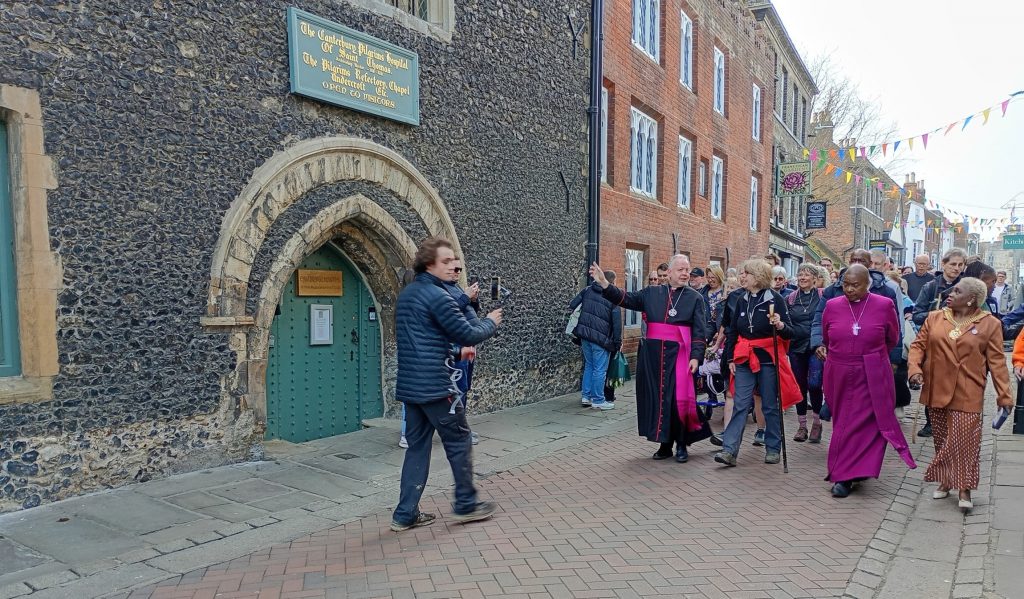
You may be wondering why I’m starting the KCHH blog with the archbishop’s pilgrimage, but in this medieval city, I think it is worth going back to that time and to consider briefly the rituals that marked the movements of dignitaries from one jurisdiction to another, as well as the concerns of those at the other end of the social hierarchy – poor pilgrims, and what their experience would have been like at Eastbridge, the hospital dedicated to their care.
Hence, I’m going to shine a spotlight, even if only briefly, on Westgate and on Eastbridge Hospital. Leaving aside any consideration about defence regarding Archbishop Simon Sudbury’s gift to the city of the new Westgate with its innovative gun loops, its value lay in its position. For unlike the city’s other main gates, it was on the boundary of the city’s liberty and the great archiepiscopal manor and hundred of Westgate. Thus if I could take the archbishop back 500 years, as she walked on her pilgrimage over Westgate’s drawbridge, she would have been passing from her domain to that of the city where she would have been greeted then (as now) by the mayor, sheriff of Canterbury and other leading citizens. Generally speaking, 500 years ago it would have been the king or his family who would have been greeted as pilgrims coming to Becket’s great shrine, but the idea would have been the same. For in greeting and escorting such guests from the start of their jurisdiction to its end ie Westgate to Christ Church Gate, the civic authorities were(are) fulfilling their responsibility to honour and safeguard the city’s guests. This reciprocal arrangement – the archbishop offering spiritual well-being, the monarch corporal care – is envisaged on the city’s medieval seal through Becket’s martyrdom and royal castle.
Keeping with the idea of linking medieval and modern, reciprocity can be seen as the root of the relationship involving St Thomas’ or Eastbridge Hospital. This time going back 550 years, the hospital under the archbishop’s patronage offered free overnight accommodation to poor pilgrims (the sick could stay longer) who in turn remembered this help as they prayed at Becket’s shrine the following day at the conclusion of their pilgrimage. Moreover, while at the hospital it was Alice, in the 1470s, who saw to their care, presumably a local woman who can be seen as a representative of the city – thus Eastbridge similarly brought together archbishop, city and hospital – a relationship as vital today as it was in medieval times.
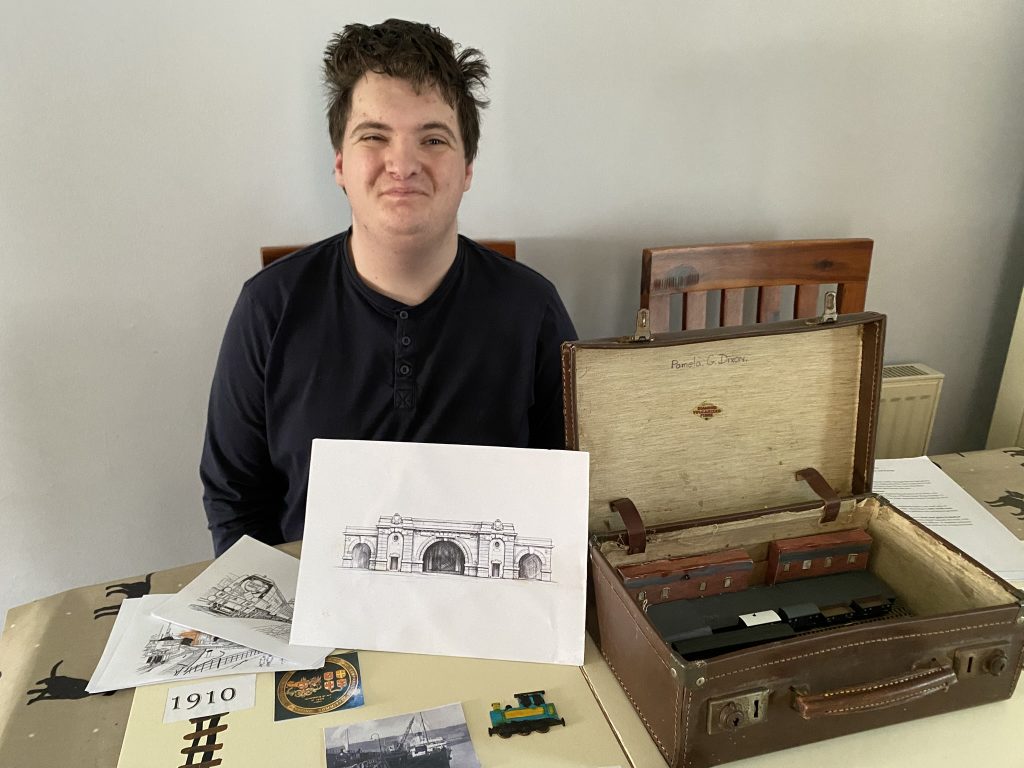
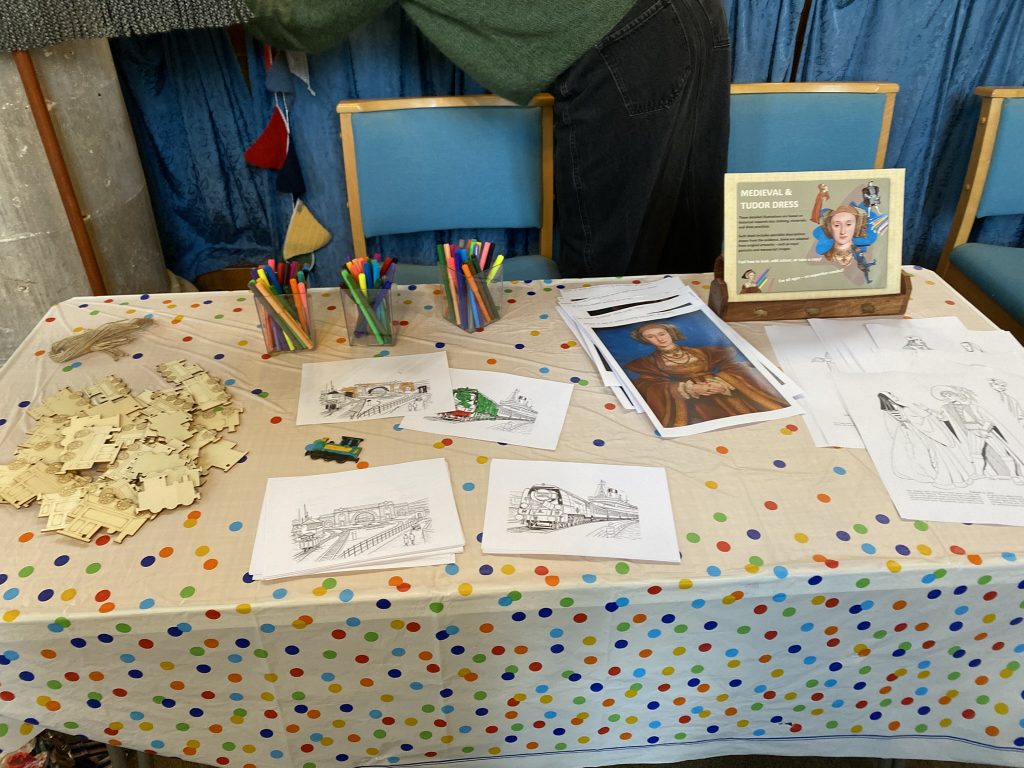
The other two events I want to feature this week are ‘Dover at Night’, which was last Friday and yesterday’s Kent History Postgraduates (KHP) group meeting, but I also want to note that the Lossenham wills group met this week and among the interesting topics discussed was Sue H‘s Tenterden Custumal project, especially her presentation to the local history group and to a creative writing group. The trail around Dover had 14 venues and we ie Christine, Jason, Kieron and I representing Kent MEMS and CAMEMS were at no. 6: St Mary’s church. Like last year we took over much of the Lady Chapel where, as you can see, we provided information banners on ‘Medieval Dover’, several information leaflets, including more on Medieval Dover, on Kent MEMS postgraduate degrees, on CAMEMS and details about the Canterbury Medieval Weekend. Also on display was Benedict Fisher’s ‘Dover Marine Station: A Gateway between Britain and Europe’ model and timeline, imaginatively constructed along a railway track with the station, complete with Golden Arrow locomotive, as a ‘model in a suitcase’. Keeping with the train theme, the family-friendly activities comprised different cut-out locos that the young and not so young could colour and make into ornaments, as well as a range of Tudor royalty to colour and decorate, both engines and monarchs proving to be extremely popular!
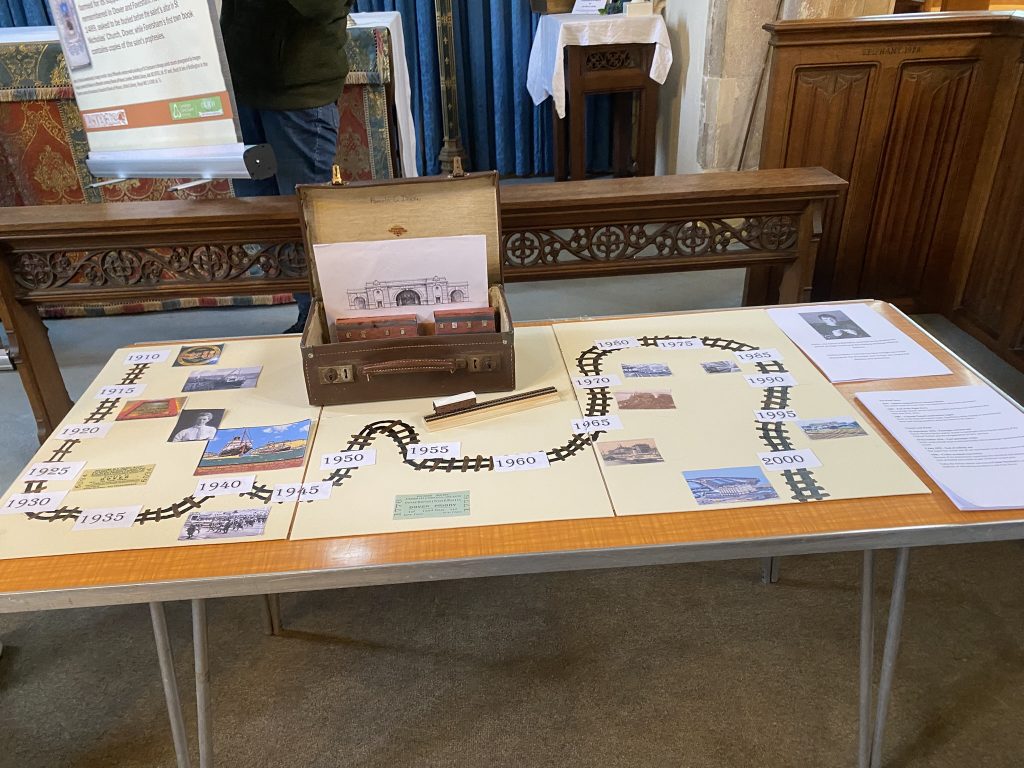
Sadly, Benedict could not be at Dover on Friday to explain to people the history of the station: from its early history – planned in 1906, site created and station constructed 1909 – 1914, its subsequent use during two World Wars, to its changing roles post 1945 – from boat trains and famous international rail travel (the Golden Arrow) to Cruise Terminal 1. However, he had provided several information sheets for people, so thanks Benedict. Very excitingly, one of the people who came to admire his model said that as a 17-year-old (she is now over 90), she had travelled on her own on the Golden Arrow and that it had been a great, and highly memorable experience.
We also had plenty of people who were interested in what Dover had been like for people living in the later Middle Ages. This interest in the lives of ‘ordinary people’ was great to see, and the Kent sources are generally excellent for such topics. Furthermore, Kieron was able to discuss with people the changes that had occurred in Dover under the Tudors, for she is researching the history of the Maison Dieu and Dover Harbour during this later period for her PhD. Similarly, as a limb of Dover, Christine had conversations about the lives of people in medieval Faversham, while Jason did the same for early modern Faversham, the subjects of their doctoral work. Thus, ours and other displays in the church were highly successful, as was the whole evening, so many thanks to the organisers including Martin Crowther and Jon Iveson (Dover District Council) for all your hard work, and I cannot end without mentioning the hooden horses, hooden dog and a spectacular giant owl (lantern) seen flying down Dover’s High Street.
This provides a nice bridge to Christine Brandl’s presentation on her research to the KHP group yesterday. Like Angela last month, Christine took the opportunity to present an overview of her topic before offering an example to illustrate her approach. For she is investigating local, what might be envisaged as small-scale disputes, not those on a national scale, to analyse the processes individuals and groups used to negotiate with others, whether they were seeking to further their claims, trying to find resolutions and/or find common ground with others whereby they could seek their own advantage. As Christine said, such a focus on process offers considerable scope to develop an interdisciplinary project that draws on theoretical ideas from social anthropology, for example, to gain a better understanding of the how, when, what, and why of people’s actions and motivations when examining formal and informal mechanisms, as well as the roles of community practice and local custom.
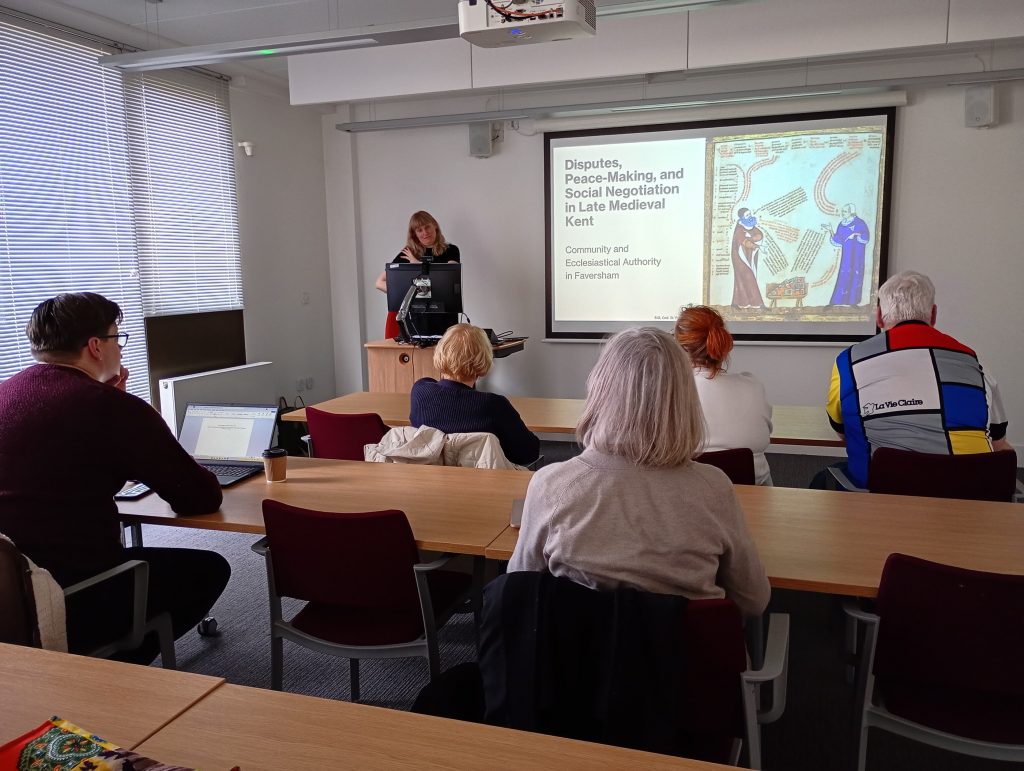
For the last part of her presentation, she focused on the next stage, which is her study of Faversham before investigating other types of town in Kent. To facilitate this, she has created a relational database and is about to start her data entry using printed and documentary primary sources as a pilot study. Consequently, she has reached an exciting point in her research and, as at previous presentations, this generated interested questions and valuable comments from her fellow postgraduates. So thanks everyone and next month it will be Jane Joyce.
Finally, for the next blog I’ll be able to report on the work by MEMS postgraduates and others who are working on an exhibition, featuring Chaucer’s Canterbury Tales, pilgrimage and maps, to be displayed at the Canterbury Medieval Weekend. Hence, thanks in anticipation to Kylie, Elijah, Jamie, Tressa, Tris, Siena, Angela as well as Torin Brown, Ryan Perry and Karen Brayshaw.
Categories
academic Blog Posts Canterbury Early Modern Events Exhibition Heritage Kent Middle Ages News TudorsHome