
Stop press – Canterbury Medieval Weekend 2026
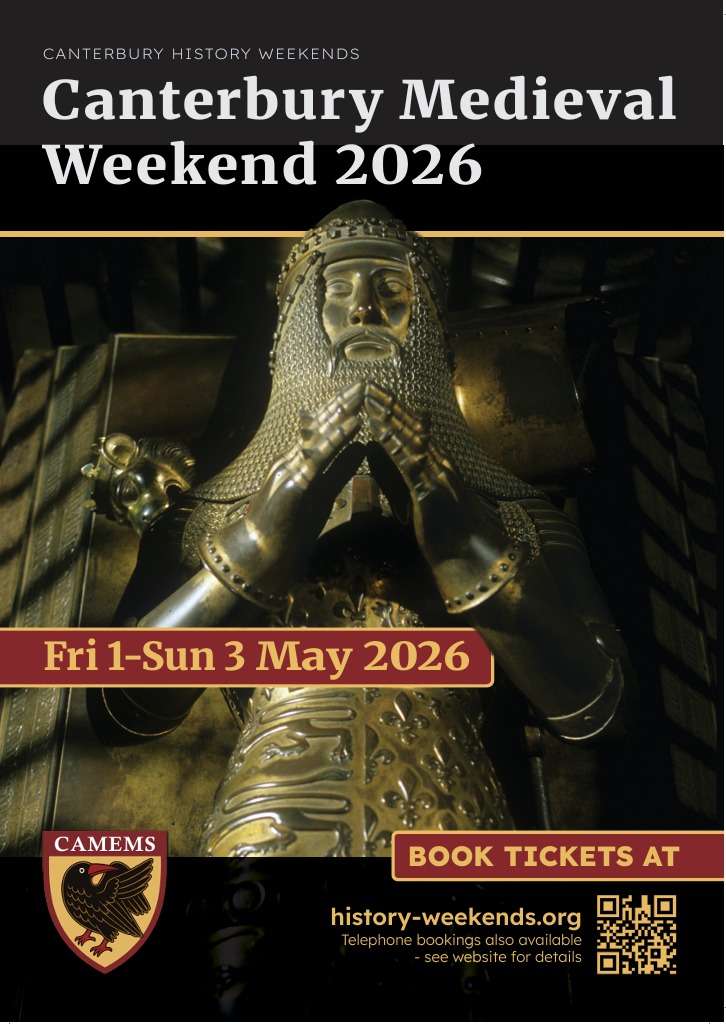
The headline news this time is that the Canterbury Medieval Weekend 2026 website has gone live and is now open for ticket sales at: Canterbury Medieval Weekend 2026 so please do have a look because I think it is a very exciting programme that will take place from Friday 1 May to Sunday 3 May at the University of Kent in Canterbury.
For those new to these History Weekends, the ethos behind them is to provide those attending with the opportunity to hear academics and other experts talking about their chosen medieval subjects, thereby bringing new research to new audiences. The talks are categorised under: Royalty & Nobility; War & Politics; Social History; and Religion & the Arts and those attending just book the talks they are interested in – a medievalists pick-and-mix. As in previous years, the intention is to raise funds for postgraduates who wish to study for higher degrees in Medieval and Early Modern Studies. To do this we are working with CAMEMS and after costs the money from ticket sales etc will go into the CAMEMS postgraduate bursary fund, so please do support the Canterbury Medieval Weekend if you can and are interested in this fascinating period.
Over the coming months I’ll feature more of these speakers and their talks, but bearing in mind that I met up with Canterbury Cathedral’s pilgrimage officer Torin Brown last week and attended the monthly Eastbridge trustees meeting this week, Eastbridge or St Thomas’ hospital having accommodated poor pilgrims in medieval times, I think this time the topic should be pilgrimage and the cult of saints. Next May we have 3 speakers that fit this theme, one on the Friday evening and then two more on Saturday.
For on Friday we have Professor Rachel Koopmans, the foremost expert today on the Becket Miracle Windows who will be speaking on ‘Miracles Rediscovered: Thomas Becket and Canterbury’s Marvellous Stained Glass’. As Rachel says, “the “miracle windows” of Canterbury Cathedral are full of action and human drama, as well as being one of the greatest artistic treasures surviving from the medieval period. Furthermore, the new examination of these windows in Canterbury’s conservation studio has revolutionized our understanding of their creation in the wake of Thomas Becket’s murder and the growth of his cult in the late 12th and early 13th century. This presentation will focus on the latest window to be analysed, numbered nIV, in which the glaziers pictured cures of lameness, paralysis, insanity, kidney pain, stomach ache and malarial fevers.” Consequently, we are exceedingly fortunate to have such a distinguished speaker who is focusing on early medieval stained glass that is at least on a par with that from the great French cathedrals, including Chartres.

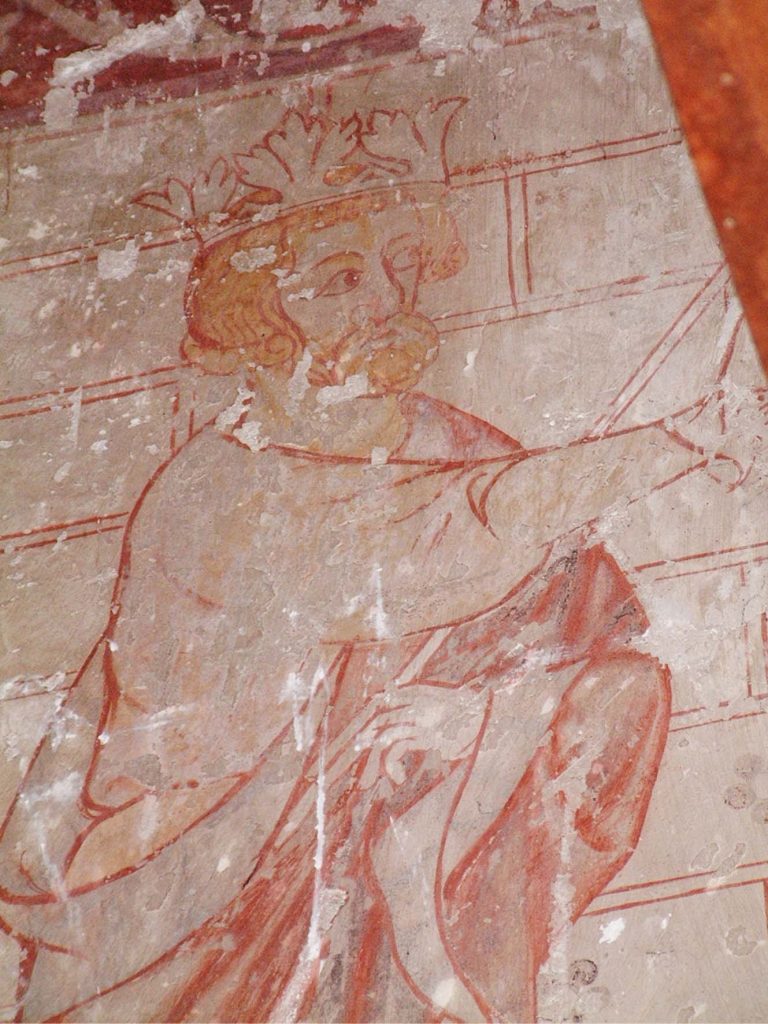
Then on Saturday morning Dr Angela Websdale will present findings from her recent doctoral thesis on the wall paintings and the context behind their creation at St Mary’s church in Faversham. This is a fascinating subject that highlights networks and connections involving Westminster Abbey, Canterbury and Faversham. Thus, as Angela says, “Come and hear how Canterbury Cathedral, the Maison Dieu, Ospringe, and the patronage of King Henry III, influenced one medieval Faversham parishioner to commission a painted scheme of monumental images that have a direct correlation with imagery once found at Westminster Abbey and the Plantagenet court.”
Keeping to this same era and to some of these personages on Saturday afternoon, Professor David Carpenter, whose monumental biography of Henry III has reshaped our understanding of this 13th-century monarch, will examine the relationship between Henry and Saint Edward the Confessor. As he notes, “King Henry III’s attachment to Edward the Confessor was unique. No other king, before or since, was devoted to a patron saint in anything like the same degree.” For those attending David’s talk, he will explore the origins and significance of Henry’s attachment. Moreover, he will consider how it both helped and hindered Henry’s kingship because it gave the king spiritual solace and was directly responsible for his greatest achievement, namely the building of Westminster Abbey, yet it also contributed to some of his worst political decisions. Professor Carpenter’s talk will conclude by contrasting Henry’s devotion to the Confessor with his far more qualified attitude to Thomas Becket.
Staying with pilgrimage and Becket, you may be interested to know that Michael Byrne, a PhD student in the Kent MEMS community, is studying a Middle English life and passion of Becket that was produced in late 15th-century Canterbury by one of the priory monks. Such a text might have appealed to local people who had a special devotion to the saint and even though we can only trace a few such people because of the nature of the surviving records, wills are useful. For example, Alice Byng offered a gold ring with a sapphire to Becket’s shrine, while William Chilton gave another ring with a ‘poynt diamond’. Equally, some Canterbury citizens sought to provide for the many candles around the shrine and amongst those who bequeathed wax were Roger Rydle, who gave an impressive 100 pounds to be made into thirteen large tapers. Of the known benefactors, Thomas Prowde gave the considerable sum of 5 marks for lights at the shrine and John Grey left 40d for the same purpose. Another who provided money was John Kendall, bequeathing 12d to Becket’s shrine and a similar sum to ‘the hede’, presumably the Corona chapel shrine, while Thomas Mason’s wife was to sell his tenement with 20s from the proceeds gifted to St Thomas’ shrine.
Yet it is interesting to note that some local testators looked to other local shrines, such as Geoffrey Holman of St Mary Northgate who wished to be buried before St Martin’s shrine in the church of St Gregory’s priory, while Thomas Wykes remembered St Etheldreda’s shine at St Sepulchre’s nunnery. St Augustine’s shrine at the abbey was similarly remembered: William Cantwell left his coral beads with silver gauds and Alice Bradford gave a gold ring with a precious stone.
Certain Canterbury citizens looked even further afield. Alice Cornwaile expected that her executors would ensure her gold wedding ring would be taken to the shrine of Our Lady of Walsingham, and Alicia Brent was equally determined that her gold ring with a sapphire should be given to the same shrine. However, she also looked overseas, bequeathing a similar ring to the shrine of St James de Compostela. In contrast, Hugh Aleyn intended to go on pilgrimage himself to Compostela, but he did not forget his cathedral leaving it 40s towards repairs should he not return. Others intended their relatives should undertake such pilgrimages on their behalf after their decease, including Alice Norman who wished her brother to go to Rome at a specific feast day to the chapel of Scala Celi where mass was to be celebrated for her soul and that of her deceased husband.

Nevertheless, even if St Thomas’ shrine was not the only one remembered in Canterbury, it is feasible that a vernacular life and passion of the saint may have been intended to enhance the cult, potentially being read at the priory during visits by distinguished guests. Alternatively, it was perhaps even employed in some way through a narration of events covering Becket’s murder as it was enacted annually during the city’s pageant on the eve of the Translation. For it is worth remembering that the churchwardens at St Dunstan’s had texts of several saints’ lives and drama was an important part of parish and civic life in many parts of late medieval Kent.
Finally, and these will feature in a fortnight’s time, advance notice that there will be a 2-day conference on the history of the Cinque Ports on Friday 26th and Saturday 27th June at the Maison Dieu, Dover. In addition, the annual Fifteenth Century conference will be held at the University of Kent from Thursday 3rd to Saturday 5th September 2026, so please watch this space.
Categories
academic Blog Posts Canterbury Events Kent Lecture Middle Ages NewsHome
1 Comments
Great the Medieval Canterbury Weekend website is up and running