
Studying conflict in society – medieval to modern
This week has seen continuing preparations for the Canterbury Medieval Weekend, hence many thanks to Karen Brayshaw and her colleagues in the University’s Special Collections and Archives, to Ryan Perry and to the MEMS postgraduates who have been working on the exhibition, we are almost there.
In other areas, too, there has been considerable progress, and many thanks to MEMS postgraduates who were at the meeting on Wednesday, it was good to get the two lecture theatre teams in place and to sort out other administrative and logistical matters ahead of next Friday. I hope you all have a highly enjoyable time as members of the Canterbury Medieval Weekend’s Welcome Team as you help our speakers, chairs and attendees, there will be a full report in the next blog.
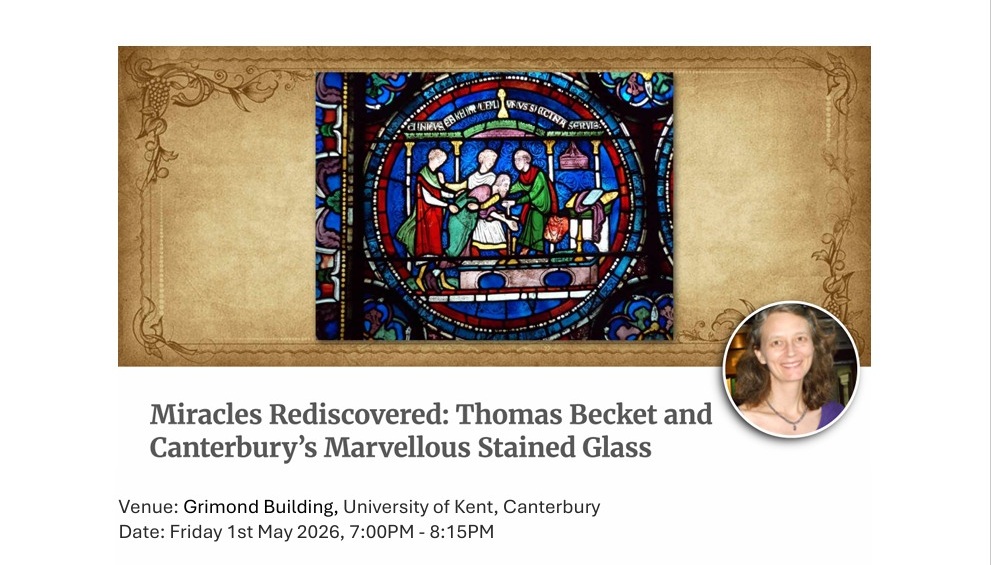
If you haven’t booked your tickets yet, there are spaces in all the lectures, so please see the website at: Canterbury Medieval Weekend 2026 where you can find talks on a wide range of aspects. For example, if your interest concerns medieval pilgrims, pilgrimage and the cult of saints, why not try – Rachel Koopmans, Angela Websdale, David Carpenter and Eliot Benbow. If conflict in varying forms and defined broadly – from peasants to kings – in the Middle Ages (and beyond) takes your fancy and not surprisingly this is the largest category, look out for Jack Newman, Richard Eales, Marc Morris, Christopher Dyer, Katy Mortimer, Matthew Johnson, Joanna Laynesmith, David Grummitt, Malcolm Mercer, Imogen Corrigan and Helen Castor. For those with literary interests (again defined broadly), including the importance of symbolism, a central feature of medieval culture, do try Ryan Perry, Robert Gallagher, Diane Heath, Caroline Barron and Catherine Delano-Smith.
However, in the meantime it gives me the greatest pleasure to announce that Maureen Mcleod’s doctoral thesis has passed and been signed off by her examiners, so many congratulations Dr Mcleod! Maureen did her Masters in MEMS a few years ago and is, therefore, a former member of the Kent MEMS community and more recently a member of the Kent History Postgraduates (KHP) group, which has now reformed within Kent MEMS with people from both Kent and CCCU. Consequently, we’ll celebrate Maureen’s doctoral success at the earliest opportunity!
For this week, one of the other topics I shall be reporting on is the latest KHP presentation by someone at the other end of the PhD journey. Moreover, Jane Joyce’s presentation was not the only one I attended this week because I also made it to Jonathan Arnold’s research seminar to the MEMS community and to John Bulaitis’ lecture to the Canterbury Commemoration Society on the Swing Riots in 1830, especially in east Kent. While for the other end of the county, it was the Lossenham will group’s informal online meeting yesterday (Friday) and amongst the topics discussed was the far greater variation, but also specialism, seen in domestic and occupational items in the inventories from the Rother Levels during Elizabeth I’s reign.
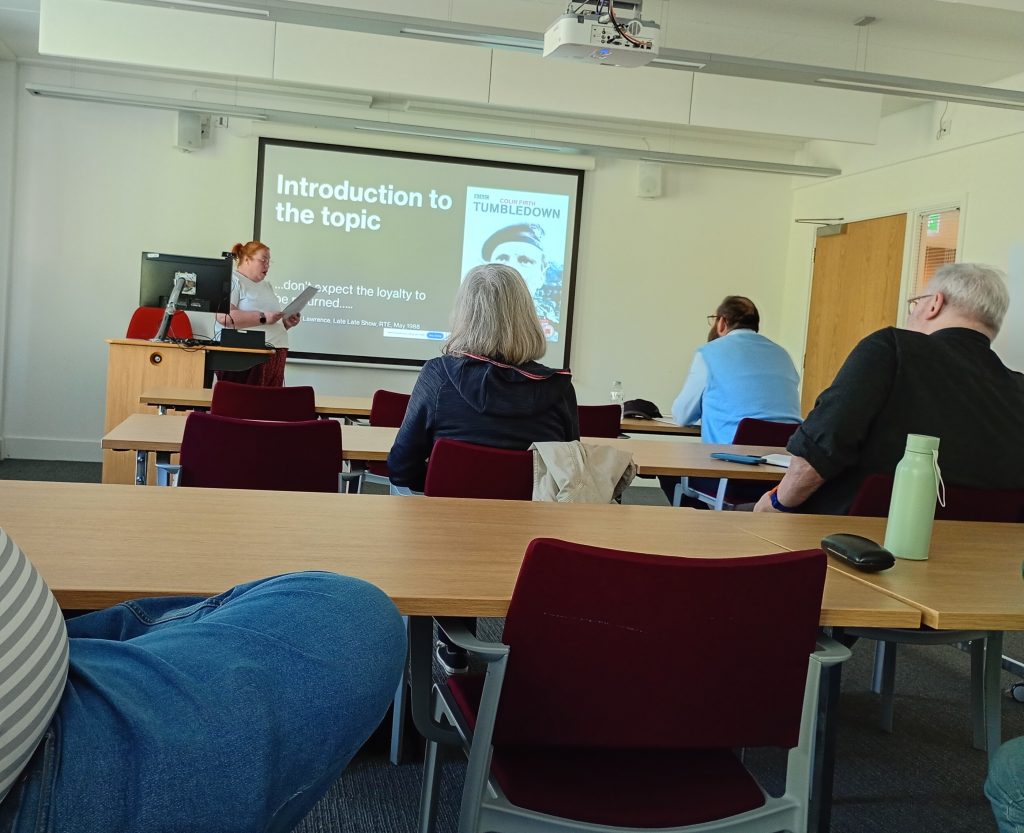
Starting, therefore, with Jane Joyce’s presentation on her proposal for a PhD research project entitled The Welfare and Medical Provisions for the Military: along the River Medway 1660–1870, she began by explaining how she had come to this subject from her professional and personal interests and background. Then to introduce her chosen topic, she first looked at the military service and treatment received thereafter by Lt Robert Lawrence, who was badly injured in the Falklands War and whose story is told in the BBC production Tumbledown. This she contrasted with the experience of Thomas Bean, a Kentish soldier in the late 17th century, which she has traced using the records from the quarter sessions, to highlight differences, but in some ways far more similarities regarding their experiences – an interesting demonstration of continuity.
From there, Jane outlined her proposal to the group and why she had chosen this period, the central area of study – topic and geographical area with the rationale behind such decisions. She has decided to use a multi-disciplinary approach, which seems a very sensible option, and her social groups will extend beyond the military personnel to encompass dockyard workers, as well as the families of all her chosen groups. This brought her to her research questions and having gone through these for her audience, she outlined how she intends to approach her analysis thematically.
This very interesting proposal was well received by the group, thereafter generating a considerable number of questions and comments, indeed to such an extent that most people headed to the café afterwards to continue the discussion over coffee. However, I wanted to hear Jonathan Arnold’s (holder of the Michael Ramsey Chair in Theology) paper and headed instead to Darwin College.
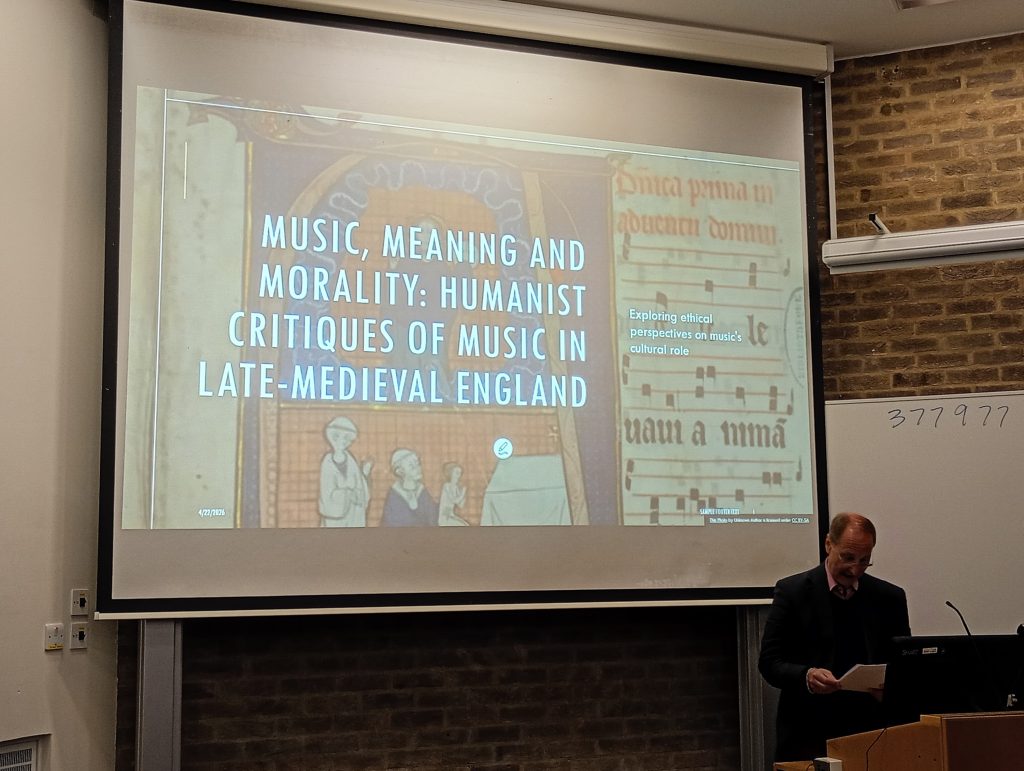
As Jonathan said, the development of church music from the later 14th century through to the 16th century, in part a response to new Humanist ideas coming into play, first in Italy and soon after in northern European countries too, meant that it became a battleground between those who championed liturgical singing based on their reading of classical philosophers, their opponents drawing on others as well as what they saw as contemporary ignorance and misuse, a debasement where choristers, for example, did not understand what they were singing. Such recent study has opened up a range of ideas for musicologists, yet this approach is also of considerable interest to those studying late medieval culture more broadly, especially in the fields of philosophy, theology and history. Thus, seeing church music, in broad terms from plain chant to polyphony, as the way in to explore these cultural shifts and, at times retrenchments, was fascinating, especially concerning the impact on schooling and education more broadly. For this, Johnathan investigated the career of John Colet, who first turned his attention to attempting to reform in the early 16th century, as he saw it, the vicars choral at St Paul’s cathedral before deciding instead the reforming of education for young boys was a better approach through the establishment of St Paul’s school.
During his presentation Jonathan provided his audience with several examples to illustrate this move in broad terms from plain chant to polyphony, how it was done and what lay behind the different stages. This interesting approach sparked several questions afterwards and as with Jane’s presentation, members of the audience joined Jonathan afterwards over coffee to explore some of his ideas still further.
The third presentation this week was given by John Bulaitis, formerly a Senior Lecturer at CCCU, who following on from his highly successful book on the ‘Tithe Wars’ in early 20th century east Kent, in particular, has now turned his attention to the Swing Riots and the allied protest which culminated in the Battle of Bossenden Wood. For the latter, please do check out a new website by a group that is seeking to raise the profile of this fascinating episode in the class struggle between farm workers and the larger landholders: Battle of Bossenden Wood – Website and Memorial Group in the early 19th century.

To return to John’s talk, in many ways the epicentre of the Swing Riots was Elham, however the rioting did spread well beyond Kent to Essex and Sussex, in particular, and across southern and eastern England more broadly. Yet, as John said, Swing is not well known generally, especially the significance of Kent, and he feels such struggles between the larger landholders and the poor agricultural workers should be far better known and understood, especially bearing in mind how much more the Tolpuddle Martyrs are commemorated. To illustrate just how important John considers Swing to be, he took his audience through the root causes such as declining wages, rising prices, under and unemployment, and to cap it all the appearance and increasing use of threshing machines, thereby taking away winter work for farmworkers. He then provided a chronology of the riots in Kent, including how they spread geographically, the initial lenient response by the authorities and then how the attitude of the authorities hardened drastically, culminating in the hanging of 19 men including 2 brothers from Blean, the transportation of several hundred others and the imprisonment with hard labour of the largest number convicted. John concluded by underlining why he believes the Swing Riots merit far greater attention by historians and in the popular consciousness more broadly, and one of his aims is to write a book on Swing, putting Kent at its heart. This is an excellent idea and I’ll look forward to seeing it, as I’m sure will many in Kent and beyond.
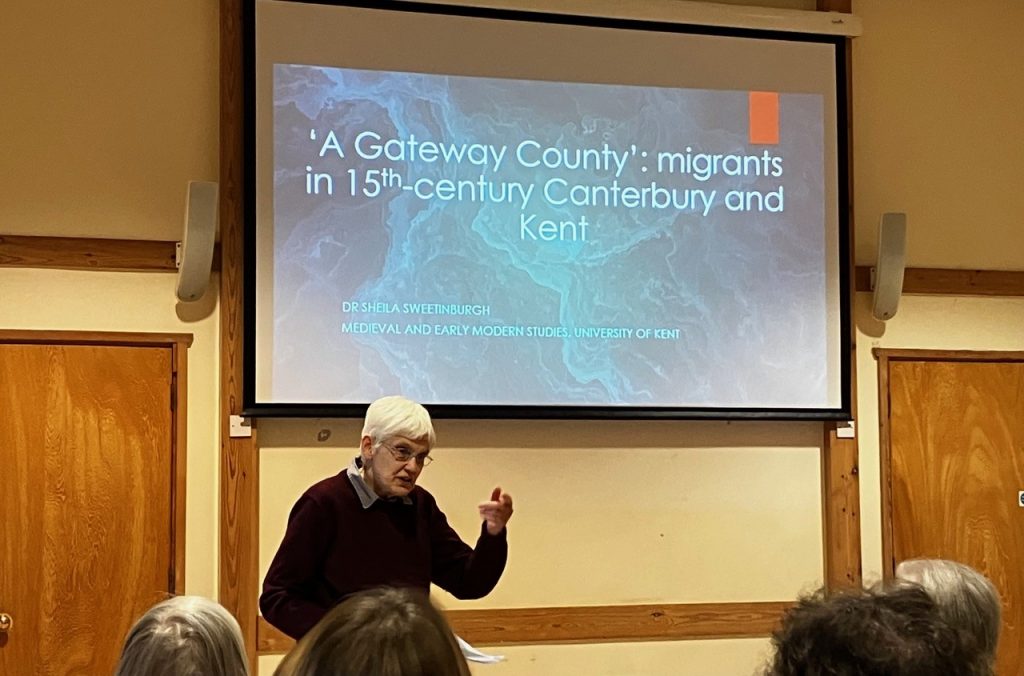
To finish, I just thought I would mention that interest in immigration in the past remains of interest and my talk on 15th century economic migrants in Kent to the Canterbury branch of the Kent Family History Society produced numerous questions. Finally, I understand the BBC Radio Three programme on Christopher Marlowe in Canterbury was broadcast last week, now available on BBC Sounds, where you can hear Rory Loughnane, Charlotte Cornell, Peter Henderson and me.
Categories
academic Blog Posts Canterbury Events Exhibition festival Heritage Kent Lecture local and regional history Middle Ages News Tudors VictorianHome