
Showcasing medieval studies – from troublesome kings to international trade
As we are now into the second full week of March, we are less than 2 months away from the Canterbury Medieval Weekend on the 1-3 May.
Thanks very much to those who have booked tickets already, and for those you haven’t, please do check out the online programme because there is a broad range of topics covered by our excellent speakers: Canterbury Medieval Weekend 2026 . These range from 3 lectures on pilgrimage taking diverse angles (talks by Rachel Koopmans, David Carpenter and Angela Websdale), to the reigns of three extremely different kings – from the warrior king, Edward I, known as the ‘Hammer of the Scots’ (talk by Marc Morris) to the totally unwarlike Richard II (talk by Helen Castor), whose finest hour in some ways was his response as a boy king when he bravely met the rebels in 1381. Peasants will feature in Christopher Dyer’s lecture as he explores the lives of these medieval farmers and their artisan neighbours in medieval village society, while the toys their children might have wished for will be investigated by Eliot Benbow, alongside medieval badges and other objects, all markers of everyday life.
For those interested in medieval books, texts and manuscript illustrations, we can offer you talks by Ryan Perry, Caroline Barron and Robert Gallagher, while animals ‘escape’ the manuscript in Diane Heath’s lecture and instead can be found on the carved stone capitals of Canterbury Cathedral’s undercroft – and who can resist a medieval dragon or a goat making music! Now this isn’t all and my list could grow much longer, but I want to leave some surprises. Thus, please do check out the website at: Canterbury Medieval Weekend 2026 we would love to see you in May because we want you to enjoy our great speakers and after expenses, income from tickets and brochure sales goes to the CAMEMS Bursary Fund to help MEMS postgraduates.
For this month, and therefore for the second March blog, I’ll be able to include reports on the ‘Dover at Night’ event, the Wills Group meeting in person at Frittenden, which will include an update on the Tenterden Custumal project and Christine Brandl’s presentation to the Kent History Postgraduates group in Kent MEMS. However, for now here are details of ‘Dover at Night’ which will take place on Friday 20 March, 5 to 9pm with displays, exhibitions and child-friendly activities across a broad range of venues in the town, we (Kieron Hoyle, Christine, Jason Mazzocchi, Benedict Fisher and I) will be in St Mary’s church so do come and see us. For details, please see: Dover at Night | UK Something A Little Different Reviews | DesignMyNight for this free town-wide event.

Moving on in time, so will feature in the first April blog, Jason will be giving a talk on the oyster maps to the guides of the Faversham Charters’ exhibition in the town’s Visitor Information Centre on Monday 30 March. If you are interested in early modern maps, especially these oyster maps, he will be speaking on this topic to the Faversham Society on 11 June, 7.30pm at the Faversham Assembly Rooms. For further details, including how to book, please see: Events – The Faversham Society .
Indeed, June will be a busy month because towards the end on the month on Friday 26 and Saturday 27 it will be the Cinque Ports conference at Dover’s Maison Dieu. Almost all the speakers’ abstracts are now in and the full programme with booking details will be going live very shortly. It is an exciting programme with on Friday under ‘Cinque Ports Administration’: Robert Blackmore, Justin Croft, Craig Lambert and me; for ‘Defence and the Royal Navy’: Andrew Lambert, Andy Plumbly, Susan Rose and Chris Ware. Then on Saturday under ‘Cinque Ports Maritime Communities’ we have Claire Bartram, David Carpenter, Gillian Draper, Jon Iveson, James Lloyd and Daisy Turnbull. Moreover, on each day there will be guided tours of the wonderfully conserved and refurbished Maison Dieu, and the blowing of Dover’s moot horn – not to be missed! And earlier that week I’ll be venturing over the county boundary into Sussex, to Lewes to be precise, to give the Annual Lewes Priory Lecture on the medieval hospitals of Sussex and Kent.
Now back to what has happened so far this month, we had a very useful meeting last week of the WEOCT-funded Maidstone History Project board, which is being led by Jack Newman, post-doctoral Kent MEMS, working with volunteers to produce a VCH Short volume on ‘The Making of Maidstone: Reformation to Restoration’. Jack is now into his second year of the project and is busy writing, amongst other activities. You can meet Jack at the Canterbury Medieval Weekend where he will be speaking on a topic linked to his doctoral thesis, the use of poetry in the 14th century to highlight ‘legal corruption’ – a fascinating subject!
As I said last time, I was at Wye early in March to give a talk to the Wye Historical Society there on migrants in 15th-century Kent and Canterbury. By way of introduction, we thought about the geography of Kent, both in terms of its position vis-à-vis mainland Europe, especially the Low Countries and France, as well as London, of course, but also further afield, and its physical features – as a peninsula with a generally low-lying coastal strip with many maritime communities whose inhabitants were engaged in a mix of fishing, manufacturing, trading and farming. Such contacts were part of what brought people in terms of economic migration, what might be termed a complex mix of pull and push factors.
With this in mind, I’m just going to mention a couple of examples involving migrants and trade from last week’s talk, one of someone who came to Kent from northern Europe and the other of a family from the Mediterranean.

My first is a man from Gdansk who seemingly had settled in Faversham by the mid-1430s. He may have been a Hanseatic merchant, and it seems likely in such circumstances that one of the major commodities he dealt in was timber. While this might appear to be stretching the circumstantial evidence too far, he may have been responsible for the chest which today sits in the vestry of St Mary of Charity parish church. This high-quality chest is from the early 15th century according to Christopher Pickvance, who was an expert on medieval chests, and is constructed from ‘Baltic’ oak. What is also interesting is that there is a very similar chest at St John’s hospital in Canterbury.
Also worth noting, Hanseatic merchants operated at the port Sandwich in the 15th century. However, it was the Genoese who appear to have resided in the port and therefore caught the attention of the royal clerks regarding alien subsidies as either householders or non-householders. Using a variety of evidence, I just want to mention the Pinelli family who developed a residential base at this Cinque Port, for it offered them good temporary storage facilities for their goods once landed, such warehousing often managed by the merchants’ commissioning agents, potential younger members of the family learning from their experienced, older merchant kin. In the case of the Pinelli family, they appear to have arrived in Sandwich by the late 1430s, and various family members continued to live there for the next five decades, with other kinsmen in London.
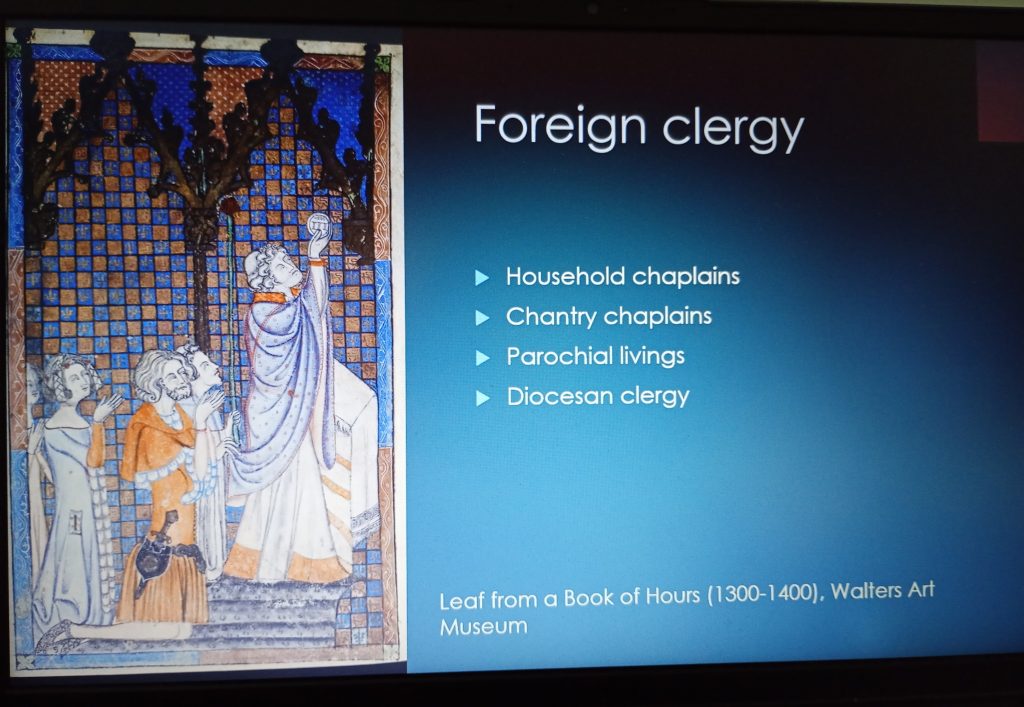
In the later years of the family’s residency, Geronimo Pinelli in 1486 hired space in an Italian carrack (bigger than the usual clinker-built Cinque Port vessels and therefore able to carry more cargo) to bring his goods and those of his fellows (in total worth over £2,000) to be off-loaded at the port. Moreover, he was not solely shipping goods from the Mediterranean, because like other Italians, he was busy importing other commodities from Flanders, hiring space in the smaller, shallower draft local vessels. The chief commodity brought from the Mediterranean was woad to be used by cloth manufacturers, thereby bringing in considerable sums to the Crown in customs dues. These overseas merchants shipped woollen cloth to mainland Europe, while among the goods they brought from the Low Countries were hops, bricks, red and white herrings, saffron and madder.
Although neither of these examples involved migrants in Wye, I did manage to find one example, a local household chaplain. Moreover, concerning such clergymen, it is interesting to note that a sizeable number came to Kent from Scotland and Ireland. The audience seemingly enjoyed the talk, and it generated numerous questions and comments. This is a good omen because hopefully 2026 will see the publication of ‘Migration through the Ages in Kent’, edited by Elizabeth Edwards and David Killingray.
Categories
academic Blog Posts Canterbury conference Early Modern Events festival Heritage Kent Lecture local and regional history Middle Ages NewsHome
1 Comments
Thanks for this. It’s very interesting about the Pinnelli family. In the alien taxpayers list there is the name Pannyl from genoa and who were merchants. The Pannells are my ancestors.