
Lewes and Canterbury – more fascinating history
Well, it has been another action-packed week from last Wednesday until we move into July which means sandwiched between talks for the Lewes Priory Trust and the Canterbury Commemoration Society, there was the excellent, albeit exceedingly hot, Cinque Ports conference in the Stone Hall within Dover’s Maison Dieu. Consequently, because it is such an abundance of riches, I’m going to divide it into two blogs and save the conference to the next one.
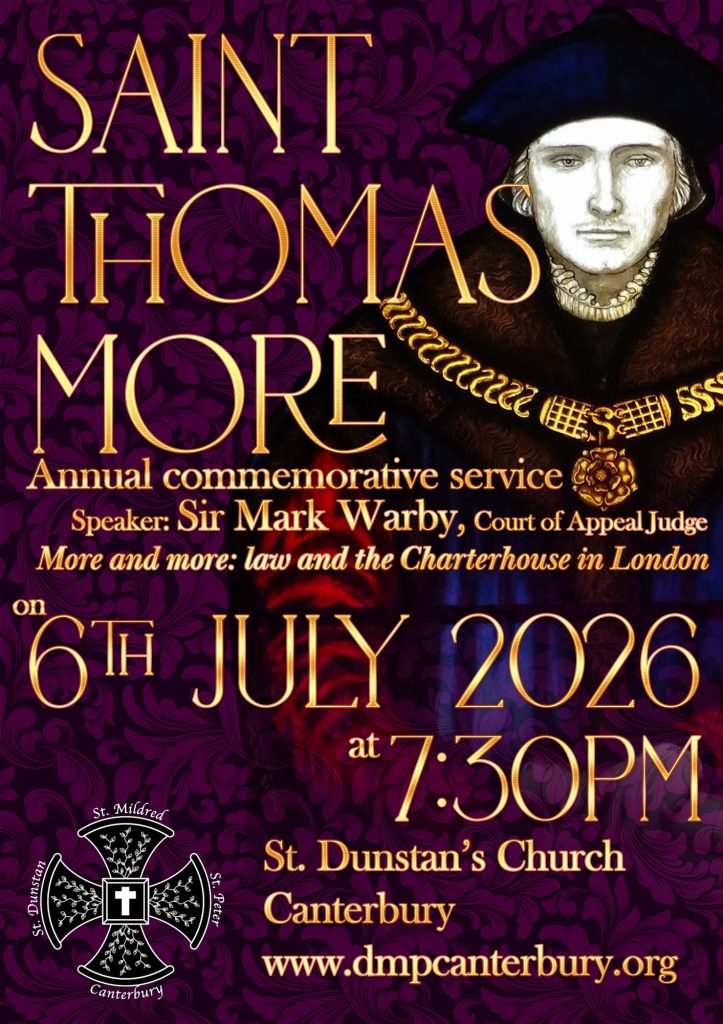
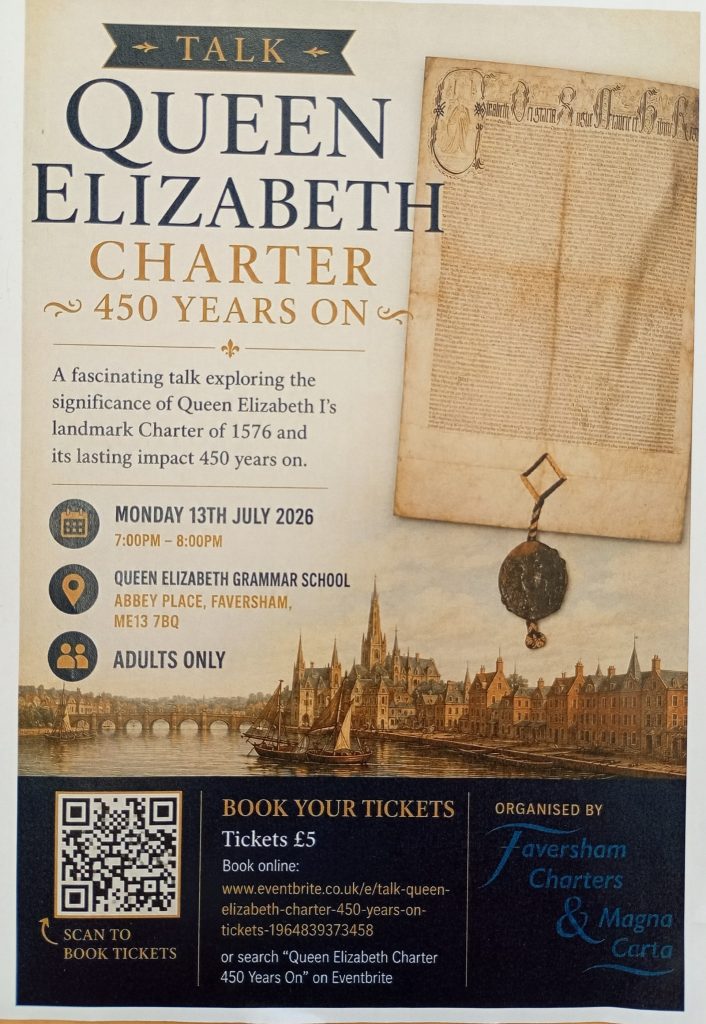
Thus, before I come to Lewes and the Canterbury Commemoration Society talk, a reminder that the Saint Thomas More commemoration service will be on Monday 6 July at 7.30pm in St Dunstan’s church, Canterbury. This year’s speaker is Sir Mark Warby, Court of Appeal Judge, and his title is ‘More and more: law and the Charterhouse in London’ and all are most welcome to attend the service. Then later in the month, I’ll be back at Faversham to give this talk on a rather special charter: Talk: Queen Elizabeth Charter 450 Years On Tickets, Monday 13 July • 7 PM – 8 PM | Eventbrite Furthermore, Dr Tracey Dessoy will be giving a presentation to the Kent History Postgraduates group, which now meets at the University of Kent, on an aspect of her doctoral thesis where she studied gentry women in the High Middle Ages, looking at those in Canterbury and its hinterland.
So now to Lewes where I was met at the station by Arthur Franklin, the chair of the Lewes Priory Trust which looks after Priory Park, the site of a premier Clunaic house in medieval England. Contained with the area are fascinating ruins of a good range of priory buildings and the Trust is keen to undertake further research on the site. To that end, Arthur is working with the National Lottery Fund to finalise an application to undertake an archaeological investigation of certain aspects of the important infirmary building and to enhance the dissemination of this knowledge and understanding to new and diverse audiences. This sounds excellent and I shall be extremely interested to hear about this project as it develops.
However, back to Wednesday 24 June and thanks to Arthur and the hospitality of the Trust, it was then a matter of heading to the Lewes Town Hall to be ready for the audience to arrive for the annual Emil Godfrey Memorial Lecture. Due to the heat, we decided the Lewes Council Chamber was just too hot and therefore moved to one of the rooms on the ground floor – very sensible!
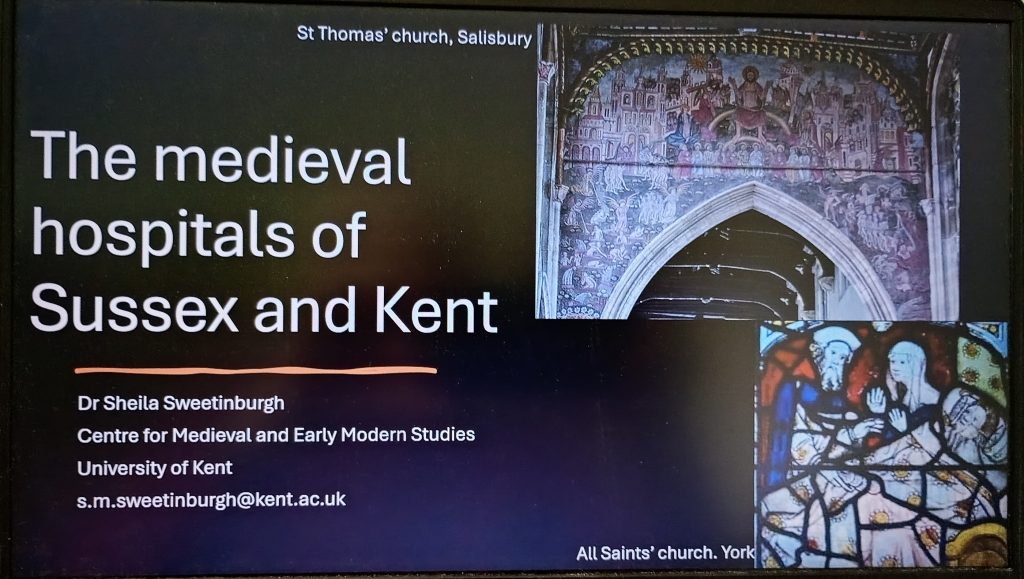
Having decided to take as my subject the medieval hospitals of Sussex and Kent, I opened with a short introduction on why supporting these charitable institutions was viewed as beneficial for both benefactors and beneficiaries by looking at this detail from a stained glass window from York and the painting over the chancel arch from Salisbury. We then moved on to thinking about spatial arrangements in both counties within these institutions using surviving hospitals and the work of archaeologists before moving on to explore the distribution pattern of such houses in both counties.
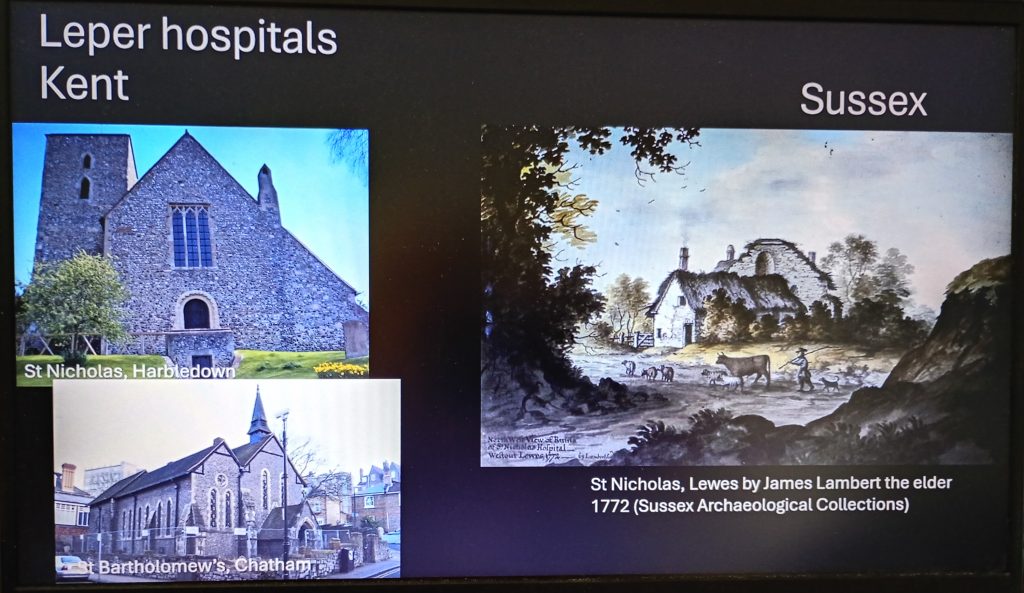
Following Professor Nicholas Orme, I had divided these hospitals into four types based on the inmates aided and the arrangements in place to do this charitable work. As this was best explored using examples from both counties, two of the leper hospitals I used were St Anthony’s hospital near Sandwich and St Nicholas’ hospital located just outside the gates at Lewes. Then for those hospitals caring for the poor and infirm, we considered among others St John’s at Canterbury and St Bartholomew’s at Winchelsea. Locating evidence of hospitals for poor pilgrims is more challenging for Sussex but there are great examples from Kent, including the two referred to today as the Maison Dieu, at Ospringe and the other similarly named at Dover. This nicely brought us on to the two types of medieval almshouses, with examples from Dartford and Arundel (well endowed) and ‘maison-dieu’ type (following Patricia Cullum) of which there are far more in Kent than Sussex. However, a trawl of the Sussex wills is likely to unearth far more! To end, I looked at late medieval adaptions and modifications, which in some ways mirrored changes in society more broadly, especially in the move away from communal living to greater privacy and separate rooms.
This sparked several interesting questions, so thanks to the audience members and I’m hoping someone will take up the challenge to find more of the poorly endowed almshouses in Sussex! So many thanks to the Lewes Priory Trust for this opportunity and to once again visit Lewes.
Now to the second lecture which was in St Paul’s church for the Canterbury Commemoration Society in aid of the new blue plaques fund, and more specifically for Nicholas Faunt’s plaque. Hopefully this will go on the front wall of The Old Buttermarket pub, that is close to where Faunt met a very grisly end on 29 May 1471. To provide a way into the subject, I started by looking at the events of that day through the words of a contemporary chronicler, as well as noting that not all the sources agree and tellingly that the account in John Stone’s Chronicle was destroyed when that page was ripped from the manuscript. We then explored who had been present, and why that space had been chosen for Faunt’s execution. This meant thinking about jurisdiction, the idea of boundaries between civic/commercial and ecclesiastical space as well as the balance of power between town and Crown.
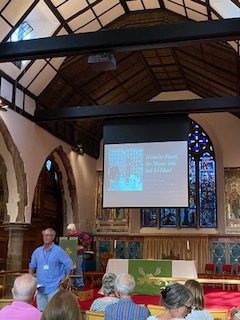
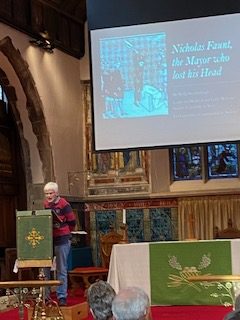
Having set the scene, I went on to examine ‘the road to the Bullstake’ by first investigating Faunt’s family and what we can ascertain about his parents, then his early career as a brewer in Canterbury and his rapid rise to become a regular jurat of the city. This I set in the context of local and national politics of the 1450s, that is what might be said to be the prelude to the Wars of the Roses.
We then moved to ‘regime change’ and what might be seen as the dangerous involvement of Canterbury in these dynastic struggles in 1460, and how the civic authorities, including Faunt, must have been highly relieved when the Yorkists triumphed at the battle of Northampton. With Edward IV on the throne working in concert with the Earl of Warwick, not for nothing known to history as ‘the Kingmaker’, the next few years were good for Faunt and Canterbury. The city was able to build on the 2 charters it had received either side of 1450 with a third charter from Edward, Canterbury thereby becoming a county in its own right. For Faunt, as a member of Warwick’s affinity, he gained the appointment of controller of tunnage and poundage at Sandwich and 4 years later was an important supplier of cloth to the Calais garrison.
However, the good times didn’t last and with Edward’s marriage to Elizabeth Woodville and the growing estrangement between Edward and Warwick, we next explored the twists and turns of the Lincolnshire Rebellion and the Readeption (1469-71) which saw Warwick working with the Lancastrians, his old enemies, Henry VI put back on the throne and Edward IV gone into exile.
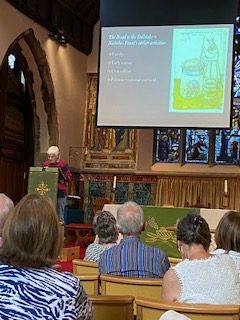
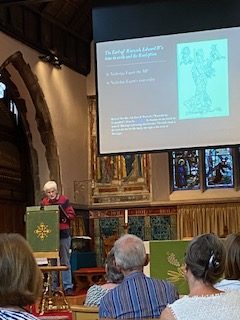
At Canterbury, this saw Faunt attend the Readeption parliament as one of the city’s MPs, his and the city’s cultivation of connections with certain local gentry, his election as mayor in Michaelmas 1470, his activities to bolster the defence of the coast and the searching out of rumours to try to keep the civic authorities informed. How successful they were on the latter is a moot point because with Edward’s return via Yorkshire in March 1471, and his subsequent successes on the battlefields of Barnet and Tewkesbury, Faunt’s fate was probably sealed anyway. But it certainly was thereafter when he led a sizeable contingent of Canterbury men to join Fauconberg’s forces when they headed towards London to support the Lancastrian cause. Their tactics remain puzzling and suggest a loss of nerve, but for whatever reason they turned back east towards Blackheath, abandoned the city’s great gun there and were, in effect, sitting targets for Edward’s triumphal forces, Faunt himself imprisoned in the Tower after being captured. Tried and convicted of treason, he was brought back to Canterbury and the rest you know.
After a short digression to explore the identities of those ‘who marched with Faunt’, a fascinating feature of the whole episode because it’s possible to track quite a few of them in Canterbury’s civic records, I continued by looking at the implications for first the city and then for Faunt’s family. These seem to reveal that yes, order was restored in the king’s favour but, and it’s an interesting but, Edward was perfectly well aware of the strategic value of working with Canterbury. Thus, in drawing the talk to a close, I highlighted the key reasons why I think Faunt deserves a blue plaque and the audience agreed!
Categories
academic Blog Posts Canterbury Early Modern Events Heritage Kent Lecture local and regional history Middle Ages News TudorsHome