
Faversham, Canterbury and Sandwich – exploring history and heritage
Starting with events coming up in June, we have MEMS Fest, which is a celebration of Medieval and Early Modern Studies at the University of Kent. This will be on Friday 19th and Saturday 20th June and is free. This is the website for booking: Medieval & Early Modern Studies Festival 2026 – A celebration of research in the Medieval and Early Modern periods at the University of Kent
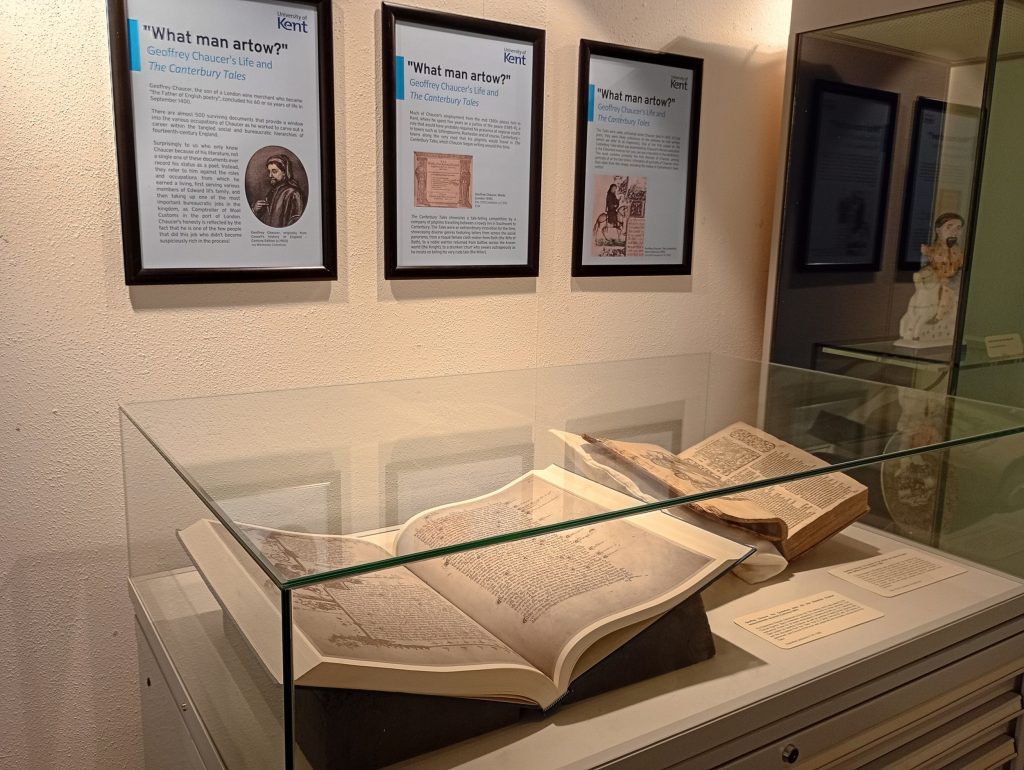
As well as a busy programme of papers by many postgraduate researchers there is a keynote lecture by Dr Alexandra Makin, two workshops on ‘Telling stories with History’ led by Dr Daisy Black and a celebration with people from outside the university to highlight the exhibition at Special Collections & Archives in the Templeman Library entitled ‘There and Back Again: Journeys through the Medieval World’, which was part of the Canterbury Medieval Weekend.
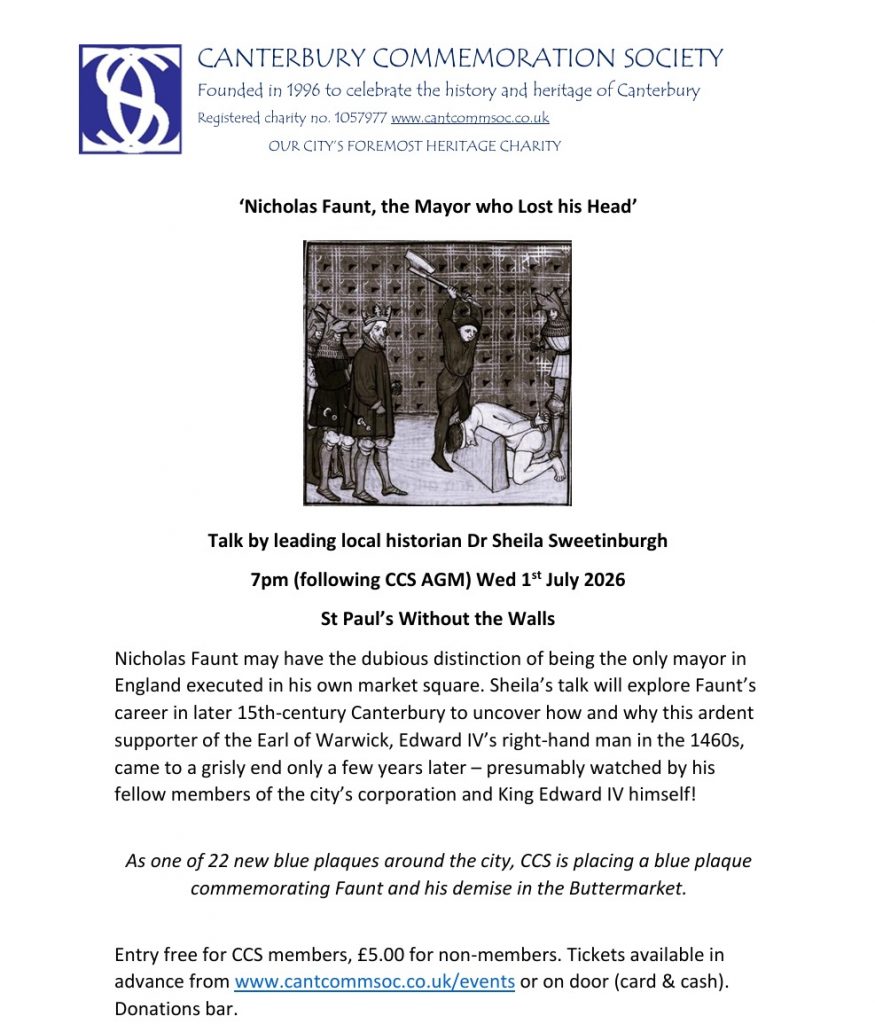
The following week has the Cinque Ports conference on Friday 26th and Saturday 27th June at the Maison Dieu in Dover. Martin Crowther has provided more information in this blog posted by MEMS Lib: https://www.memslib.co.uk/post/celebrating-the-fascinating-history-of-the-cinque-ports-and-maritime-kent?utm_campaign=e5caead3-4148-4b18-ab06-ec748fcf1417&utm_source=so&utm_medium=mail&cid=75342e8c-c859-4851-a939-864e5855e737 and for the booking link, please see: Cinque Ports Conference | UK Talk/Panel Discussion Reviews | DesignMyNight while on the Wednesday (24th June) I’ll be over the county boundary at Lewes to give the annual Emil Godfrey Memorial Lecture for the Lewes Priory Trust on ‘The Medieval Hospital in Sussex and Kent’ at The Council Chamber, Lewes Town Hall at 7pm, free and all welcome. Added to these, and as it is on 1 July, I thought I would mention a talk linked to the campaign to provide Canterbury with more Blue Plaques. This is my talk on ‘Nicholas Faunt, the Mayor who lost his Head’ for the Canterbury Commemoration Society to be held at St Paul’s church at 7pm. Free to CCS members, tickets £5 available on the door for non-members.
Now for reports on a couple of recent talks given in Kent by members of MEMS. I had a successful time when I spoke to the Sandwich History Society about ‘The ‘lost’ St Bartholomew’s Day procession of 1532’ which resulted in the imprisonment of the curate at St Peter’s, the Elys chantry chaplains and the churchwardens at St Peter’s church. Furthermore, as I discussed, it probably had a significant effect on the implantation of the mid-century religious changes in the town.
The next talk was at Faversham and was given by Dr Angela Websdale on Friday 5 June at St Mary’s church in the town about the medieval wall paintings that are largely hidden in St Thomas’ chapel (north chancel aisle) by the organ moved there in Victorian times. Her presentation drew on her doctoral thesis which is a detailed analysis of these paintings and a wide-ranging contextual exploration of the saints depicted with special reference to Plantagenet royal imagery. Fortunately, as Angela discussed, we do have descriptions and illustrations made by antiquarians that provide enough to highlight the quality of the craftsmanship, the subject matter and the spatial arrangement on the chapel’s three walls. Moreover, such information has been invaluable during Angela’s research concerning the location of similar paintings – style and subject matter at Westminster, in particular, but also echoes at Canterbury Cathedral.
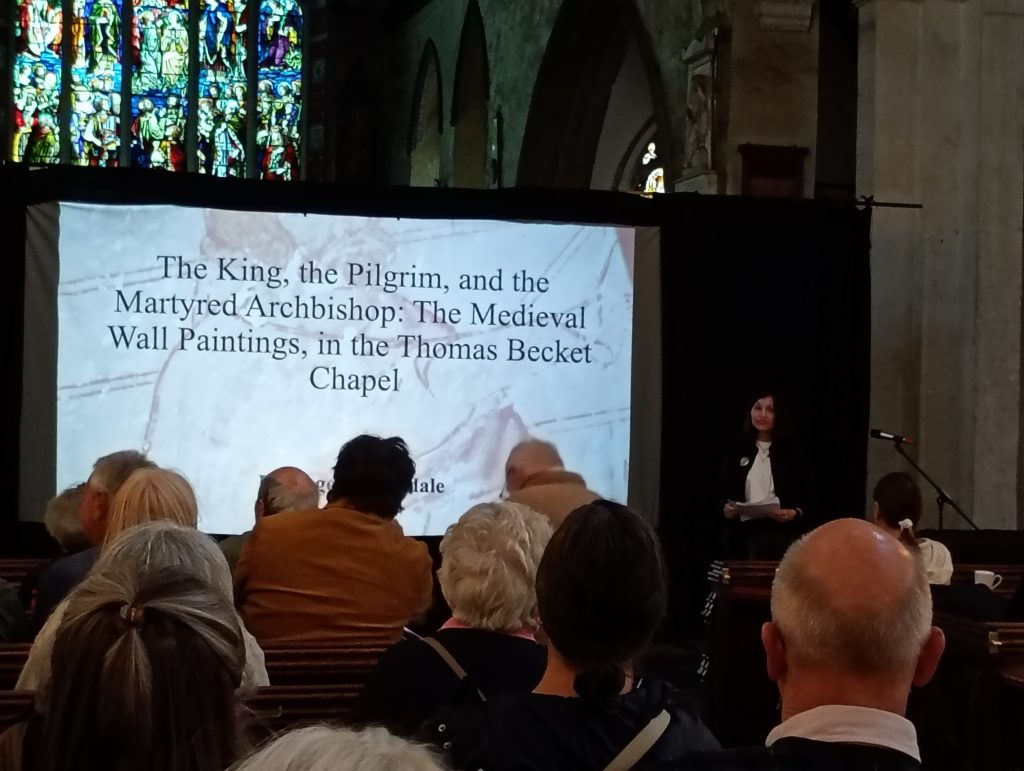
With all this in mind, Angela took the audience through key episodes in the lives of the two saints depicted: St Edward the Confessor and St Thomas of Canterbury and then considered in detail the episodes illustrated: the miracle of the ring for Edward and Becket’s murder. While previous scholarship has seen these two saints as opposites – demonstrated spatially being on opposite walls (south and north), Angela sees them as interconnected, and in the first instance this is through Robert Dod, the donor at Faversham in the early 14th century and sometime mayor of the town. Thus, as well as this interconnectedness, the identity of the patron indicates that the cult of St Edward should not be seen as exclusively elite, rather it had far wider appeal, as seen here. Nonetheless, the role of King Henry III is pivotal, and Angela discussed this in detail concerning Westminster, Faversham, Ospringe and Canterbury, as well as the implications of two disputes involving St Mary’s church which took place firstly around 1200 in Faversham and then secondly a century later.
This lavishly illustrated presentation was warmly received by the audience and generated several questions. In part the discussion focused on the obstructive position of the organ and whether its relocation would be in the least bit feasible – but that’s a discussion for another day!
Faversham was the location for the final talk report in this blog. This was given yesterday (10 June) to Faversham Society members and visitors by Jason Mazzocchi. Like Angela, much of Jason’s doctoral research is focused on Faversham, and in Jason’s case on the late Elizabethan and early Jacobean oyster disputes involving the local fishermen acting collectively against the men of Milton. As part of the legal proceedings the dispute led to the creation of 3 maps that envisage the seascape very much as the landscape was being seen by contemporary early mapmakers – matters of landholding and land use. Consequently, Jason took his audience through the 3 maps, exploring with them the features shown on the maps and how these differ in their depictions, from the parish churches and prominent and important houses to different local beacons, fish weirs and fishing grounds, for as he said, what is omitted can be as telling as what is shown.
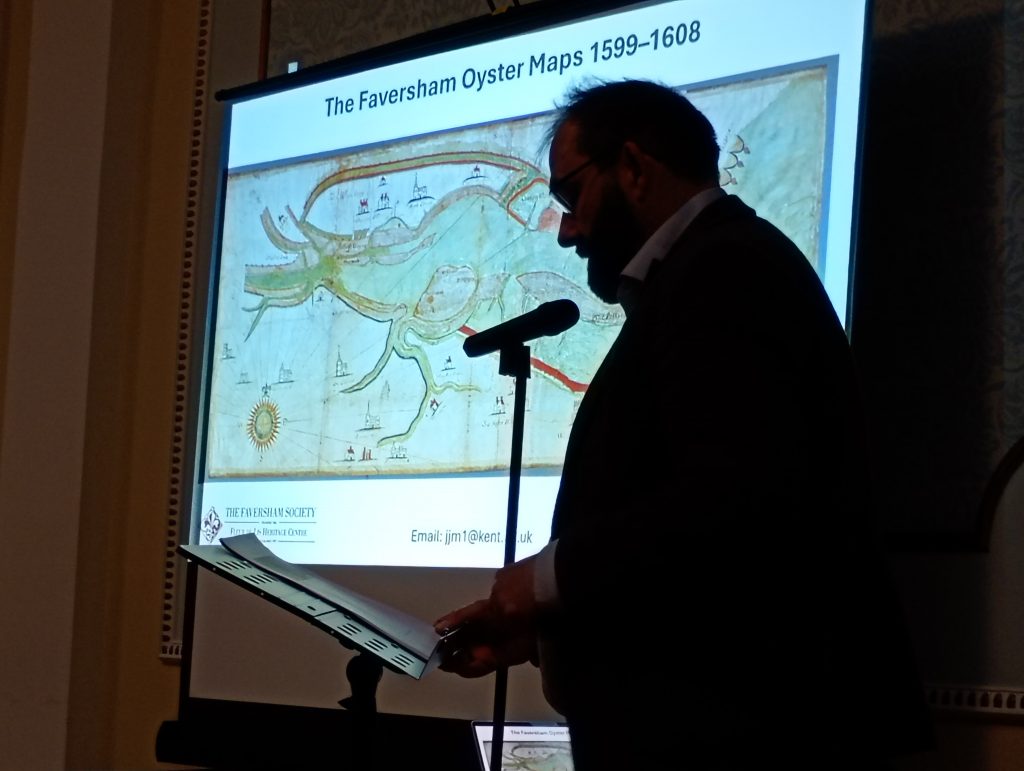
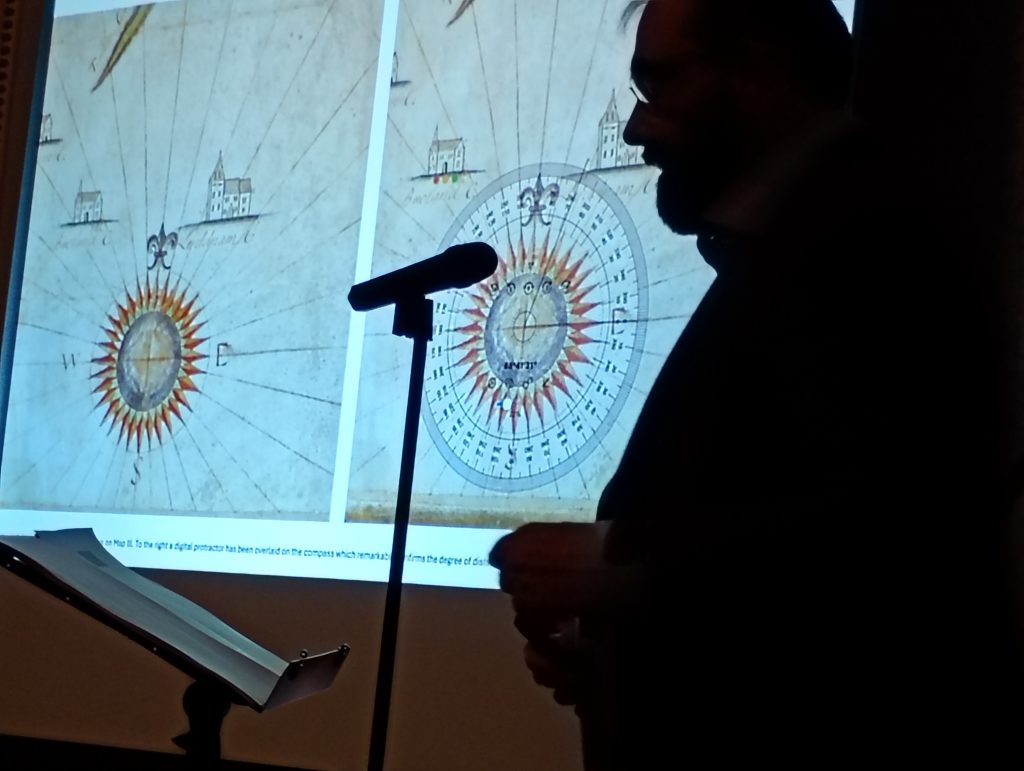
This exposition encouraged the audience to think about matters of production concerning the maps, but equally ideas about audience – consumption, because this legal case drew in the Crown as one of the maps was sent to the Exchequer. In his consideration of which map this is likely to have been, he looked at the depiction of the compass rose in detail that is only shown on one of the maps, as well as other differences such as how the foreshore is visualised by the different mapmakers.
Like Angela’s presentation, Jason was equally well received by an appreciative audience who asked several questions as well as raising points about what this map would seem to tell us about the form of Faversham’s parish church around 1600. Moreover, hopefully these connections that MEMS is building with groups in Faversham will continue to grow because, like other Cinque Ports, the town has a fantastic archive. Finally, for those interested in these maps, two are shown as part of the Magna Carta and other charters exhibition at the Tourist Information in the central market area, the third map being held at Maidstone in the Kent Archives.
Categories
Blog Posts Canterbury Events Exhibition Heritage Kent Lecture local and regional history Middle Ages News Stuarts TudorsHome