
Exploring aspects of Kent’s past
Before I come to the main report about the highly successful ‘Exploring Kent History’ day that took place yesterday (Saturday 14th February) in Special Collections and Archives at the University of Kent, I want to mention 2 upcoming events, one next Thursday and another on Tuesday 24th February.
Firstly, on Thursday 19th February there will be an evening of three talks under the overarching title of ‘Canterbury’s ‘Blackfriars’ through the Ages’ which will take place in one of the two surviving Blackfriars buildings, the Dominican Guest House (Beerling Hall) off St Peter’s Lane, an important part of the city’s medieval and later townscape, that is the Blackfriars building on the Marlowe Theatre side of the river. Mine is the first talk entitled ‘Supporting the Blackfriars: the Dominican friary in late medieval Canterbury’, which will be followed by a talk by Professor Jackie Eales. Jackie will take us post-Reformation as she will be discussing ‘Housing and Weaving: secular uses of the Blackfriars after the Reformation’. To round off the evening, Clive Bowley will explore ‘The topography of the Blackfriars in the post-Dissolution era’, which should make for a fascinating evening and if you are interested in attending, please contact Alan Robertson on 07798 645141 or email [email protected] to book. On the night, the doors will open at 6.30pm for a 7pm start. Tickets cost £10 per person (to include a glass of wine) and booking is advised (but pay at the door).
Then the week after on Tuesday 24th February Dr Barrie Cook will give a talk on ‘The Coin Hoards of Kent’, 6.30pm to 8pm, at the Westgate Hall in Canterbury. As Dr Mark Bateson the organiser says, among the hoards Dr Cook will cover are notable ones from Seasalter, Ickham, Dover, Meopham, Bredgar, Charing, Maidstone and Deal, running from the reigns of Henry II to Edward VI. These hoards will be considered in their time, place and social world. For while it is almost never possible to explain exactly why any individual hoard was deposited, they can all be placed in a context of work and life. Such medieval coin hoards are generally modest in scale and were hidden, deposited or lost by members of the working rural population — the English peasantry — and by urban workers.
Dr Cook was curator of medieval and early modern coins at the British Museum until Spring 2025. Part of his role was the cataloguing of new coin hoards from England from 1180 onwards and he is currently publishing the medieval hoards among these in detail. The first volume, English medieval coin hoards: age of the sterling penny, 1180–1351, appeared in January 2025; the second, English medieval coin hoards: from the return to gold to the Great Debasement, 1351–1560, is due in early 2026.
If this sounds of interest, please do join Dr Cook as he explores these 24 recorded medieval hoards from across Kent. He will examine both the collections he personally catalogued and earlier finds, placing them within their local settings and wider national context. Please note, entry is by ticket only at £10 per ticket and to book email [email protected] with the number of tickets you require and your contact number.
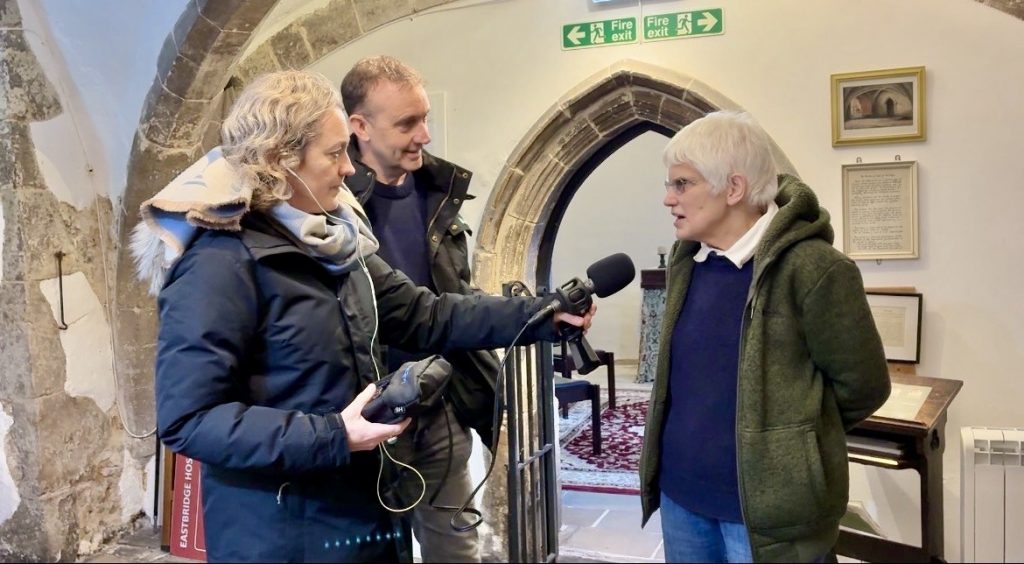
Now to what I hope will be matters of interest since the last blog and on Wednesday 4th February Eastbridge or St Thomas’ Hospital in Canterbury was one of four places visited in relation to Christopher Marlowe by members of a production company who are making a programme on Marlowe for BBC Radio 3. For even though this is for a radio programme, the team was keen to interview people in context. Having previously interviewed Dr Rory Loughnane, a Shakespeare and Marlowe specialist at the University of Kent, Peter Henderson the archivist at the King’s School, after they left Eastbridge they met up with Stewart Ross of Canterbury Commemoration Society, who guided them around ‘Marlowe’s Canterbury’.
So back to Eastbridge, and having been welcomed to St Thomas’ by Louise Knight, the clerk and receiver, and Lee Funnell her PA, Professor Jerry Brotton, the presenter, began the interview with me as we discussed how growing up in Canterbury had seemingly influenced the young Christopher, as exemplified by characters and scenes in his plays. For he would have heard a range of different voices as he walked through Canterbury from his home in St George’s parish as he undertook errands for his parents or neighbours or potentially came to school at Eastbridge in Archbishop Matthew Parker’s newly established school at the hospital. For the city has always been a cultural melting pot as people, goods and ideas come into and out of Kent, and, for example, we have considerable documentary evidence of this from late medieval and Tudor times.
We also discussed how Parker’s Eastbridge school had been part of the new statutes of 1569 to save the hospital as the archbishop changed the nature of the beneficiaries from poor pilgrims, no longer relevant following the loss of Becket’s shrine, to wounded or poor soldiers, generally returning from overseas who needed a place to stay before travelling on, the provision of an elderly, honest woman given a small daily allowance to care for them echoing the mid 14th-century statutes of Archbishop Stratford. However, there were a couple of significant changes from the medieval regulations in that during times of peace when there were no such soldiers there was to be a dole of a penny per person per week to 30 poor people; and the school. As Professor Brotton and I discussed, schooling, although previously having taken place at various institutions in Canterbury, in later Tudor times it was increasingly seen as important and Parker intended that 20 poor scholars (boys only) should learn reading, writing and singing for free. Boys between the ages of seven and eighteen could be accommodated but for a maximum of 4 years. As I said, the singing is important for several reasons. Firstly, for the hospital it meant that the boys were an integral part of the three services a week in the hospital’s upper chapel – their schoolroom – for they were expected ‘to sing loudly’. This skill (alongside their other educational accomplishments) would have been advantageous for any seeking to progress to the King’s School as scholarship boys because of the cathedral’s need for choristers. This similarly held true for any seeking a university education through scholarships to Parker’s old college of Corpus Christi at Cambridge, the archbishop having included two such exhibitions in his Eastbridge statutes. Consequently, even though there are no records of the poor scholars at Eastbridge, including the period between Marlowe’s seventh birthday and his holding a King’s School scholarship, the circumstantial evidence is highly suggestive. Also, it is worth bearing in mind that absence of evidence is not evidence of absence, and these Parker scholarships are still provided by Eastbridge today.
Consequently, having had a second conversation by the refectory, we went up to the upper chapel with its stunning timber-framed roof and lantern, the copy of the wall painting of Christ in Majesty (original in the refectory) and the fascinating misericords of a watermill and tower (gate). These possibly represent the archbishop’s Westgate mill and the Westgate Towers the misericords having come from Holy Cross church when it became the town hall. These features provided a handy backdrop to touch on the period when Eastbridge had provided overnight accommodation for poor and sick pilgrims and its other charitable and spiritual uses in the Middle Ages, before it was then time for the team to leave the hospital to meet up with Stewart Ross.
Now to yesterday’s ‘Exploring Kent History’ which was hosted very generously by Karen Brayshaw in Special Collections and Archives at the university’s Templeman Library. After refreshments, the thirteen attendees (a full house!) were welcomed by Karen and Dr David Rundle, a senior lecturer in Kent MEMS and an expert Latinist and palaeographer (among his many research interests). As he explained, the day had been arranged in association with CAMEMS, which is a charitable organisation based outside the university to provide financial help for postgraduates, as a conduit for information and to offer such educational, outreach events (including involvement in the Canterbury Medieval Weekend).

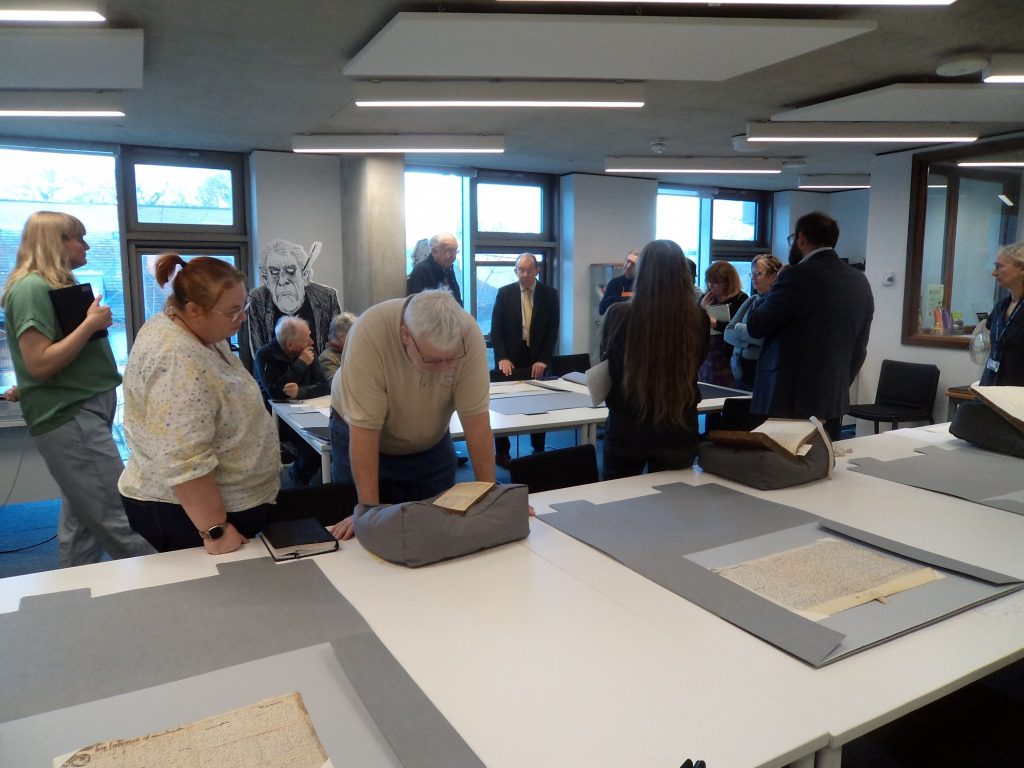
The first of three workshop sessions on the ‘History of Histories or Interrogating the Historiography on Kent’ was led by me by first echoing David’s words that we wanted the day to be about conversations sparked by people’s responses to the sources we would be highlighting, not the presenters’ monologues! And it is great to report that’s exactly what we got as there were lots of discussions in all the sessions and during the refreshment and lunch breaks. But back to Kent histories throughout the ages from the medieval and Eadmer’s History and Thorne’s Chronicle to Kent and Europe, 1450 – 1640 published just a few months ago. Having given a brief overview of the historiography, as well as noting that it is important to explore the different approaches adopted by historians – narrative, descriptive, analytical, we adjourned to the reading room. There people examined a range of books, from a translation of Eadmer’s work via Peter Manwood’s own copy of Lambarde’s 2nd edn of his Perambulation (and therefore including the map of the Kent beacons), several volumes from the 1st edn of Hasted’s History of Kent, Thorpe’s Registrum Roffense through to Smetham’s History of Stroud (1899), as well as several others. This provided lots of talking points including the use historians had made of primary sources (and which), the assessments historians had made of others’ earlier work, the range of writing styles adopted and the how this changed over the centuries.

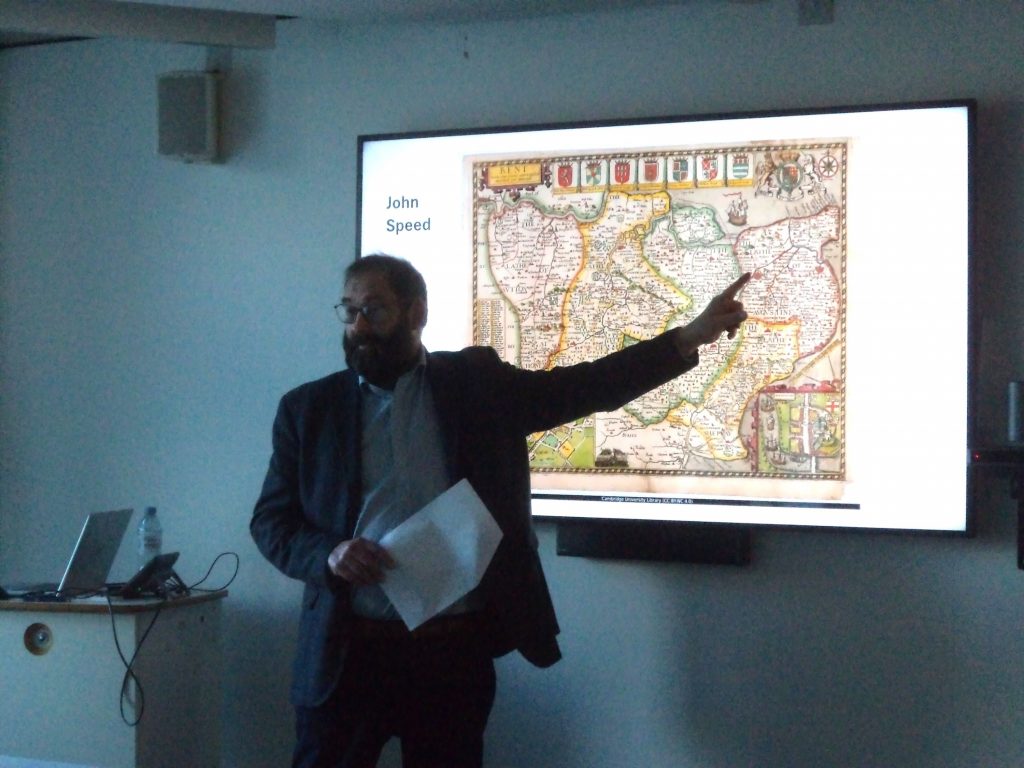
Participants then enjoyed a brief break for further refreshments to give Karen and others involved time to set up the next session, which was led by Dr Avril Leach and Jason Mazzocchi on ‘Exploring Kent Maps’. Having introduced the aims of the session that drew on ideas about maps, map-making and audience in the later 16th and early 17th centuries, Avril handed over to Jason to open up ideas about how we can explore and evaluate contextually such historic maps. To provide an example of how this can be done, he used John Speed’s map of Kent, looking at the depiction of the landscape as well as the importance placed on administrative jurisdictions such as lathes and hundreds at a time when the influence of central government was expanding, as well as looking back in time to when such boundaries were also judicial. Moving on, he explored other features of the map such as the arms of the earls of Kent, the depiction of the compass rose, the contrast in the ways Rochester and Canterbury are shown, and similarly why certain features such as churches, prominent houses, deer parks and windmills, as well as the emphasis on Kent as a peninsula, but with no reference to mainland Europe are important. Having provided plenty of food for thought, Avril and Jason invited participants to explore a range of maps in the reading room and this similarly resulted in numerous questions, comments and observations.

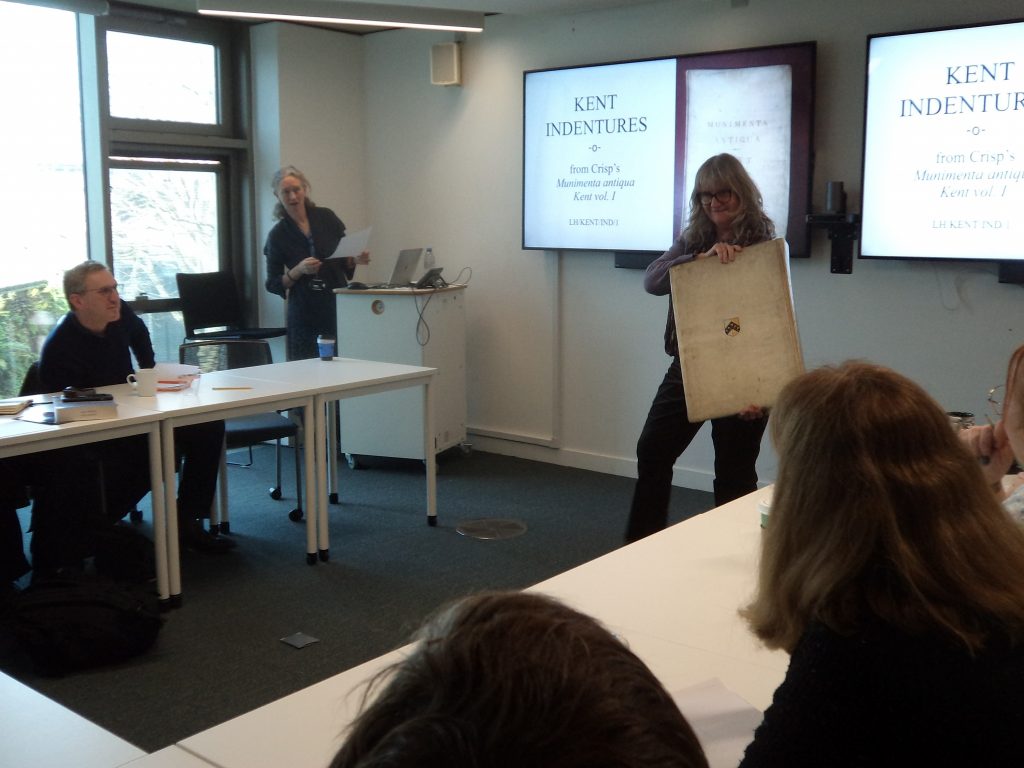
Following lunch, the third session was led by Drs David Rundle and Jacqueline Spencer who used the now unbound Munimenta Antiqua of F.A. Crisp that contains a collection of original indentures relating to land holdings in Kent from the 16th century and later. To begin the session David offered some useful information about official writings, and how, what, for whom, by whom and why they were produced with reference to early modern times, as well as the antiquarian interest in such hard written sources, especially as Crisp is an interesting member of this group of men from the late 19th/early 20th century.
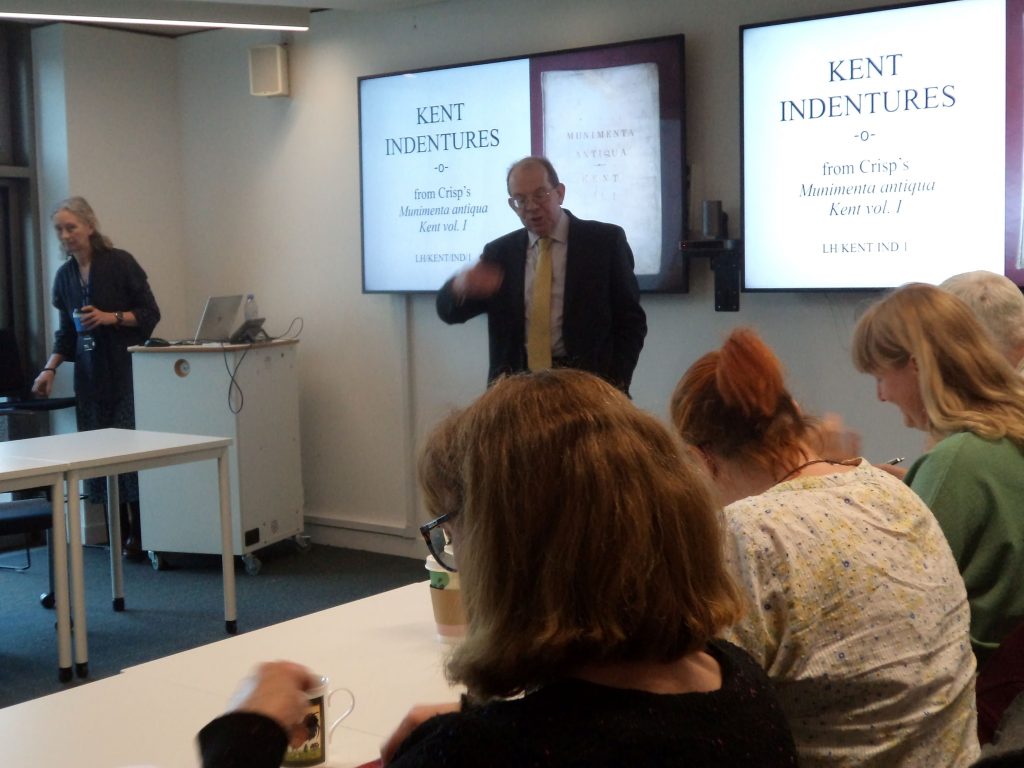
Jacqueline then examined Crisp’s collecting activities in more detail, his family interests and document types he was especially interested in, how he sought to preserve them and their history after his death, including their arrival into Special Collections and Archives and the disbinding of the book because it was damaging the indentures. With this contextual information, the participants were again excited to visit the reading room to look at a selection of these documents, to see how well they could read and understand them, and to think about how historians might employ such sources in the writing of history.

For the final session we returned to the seminar room for a short Q&A concerning issues people hadn’t yet raised and to explore whether it had been a worthwhile day from the participants’ viewpoint. Furthermore, if it had been, how might such days be done and what aspects might people want to focus on in future. The consensus was that it had been great, very enjoyable and people felt they had learnt a considerable amount which they could make use of in their own research. Thus, thanks very much to Karen, Avril, Jason, David and Jacqueline and the day had certainly showcased the value of Special Collections and Archives, the Kent MEMS MA and the enthusiasm of this research community, as well as the appetite for local and regional history more widely across the county.
Categories
academic Blog Posts Canterbury Early Modern Events Heritage Kent local and regional history Middle Ages NewsHome