
Canterbury deer parks and education in Tudor Faversham
Here are items as advance notice for September. Firstly, the annual Fifteenth Century conference, which this year will be at Canterbury, is being organised through MEMS by Dr David Rundle and me at the University of Kent from Thursday 3rd to Saturday 7th. Details of the exciting programme and how to book are at: 2026 Conference – The Fifteenth Century Conference and we will be delighted to see you.
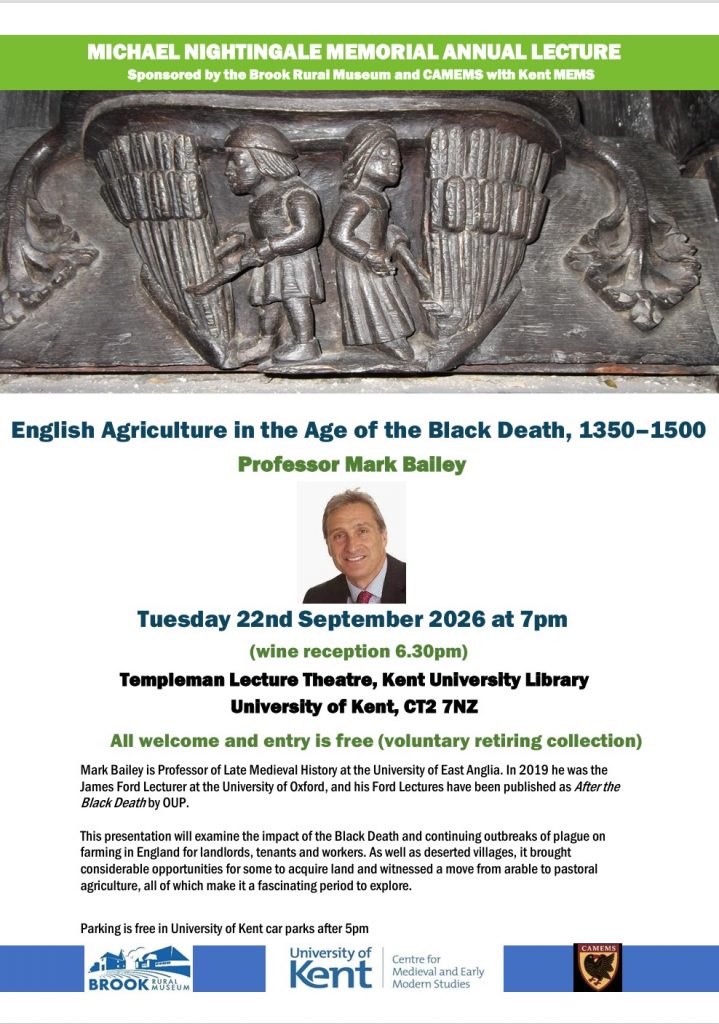
Also under Kent MEMS, in association with CAMEMS and Brook Rural Museum is the annual Michael Nightingale Memorial Lecture which will take place on Tuesday 22 September in the Templeman Lecture Theatre, University of Kent at 7pm (wine reception from 6.30pm). Our speaker will be Professor Mark Bailey (UEA) and he will be discussing ‘English Agriculture in the Age of the Black Death, 1350–1500’. All are welcome, and the lecture is free, booking not required, and there will be a retiring collection in aid of the Museum and CAMEMS.
In addition, I have been asked by Professor Jackie Eales to draw your attention to a symposium she has organised on ‘Strangers, Silk Weavers and Citizens: the Lives of Walloon and Huguenot Immigrants to England 1575 to 1800’. This will be held on Wednesday 30th September from 11.00-4.30pm at Rochester Huguenot Museum. To book please see: Symposium Tickets, Wednesday, Sep 30 from 11 am to 4:30 pm | Eventbrite
Also, I’ll be doing a couple of talks that month, firstly on Monday 14 September at 1pm for the Kent Archives, at the Kent Library and Archives Centre in Maidstone on ‘Kent’s Medieval Hospitals: from Conquest to Reformation’. These lunchtime talks are free but you need to book by either emailing: [email protected] or phoning 03000 420673, Then on Friday 25 September for the Friends of St Mildred’s in Canterbury, I’ll be speaking at the church at 7.30pm on ‘Medieval Archbishops and their cults: Becket, Winchelsey and Sudbury’. This will be in aid of church funds and tickets will be available on the door.
As we are now halfway through July, this will be the last of these KCHH blogs before September and I want to give a brief round-up of what has been happening since the Cinque Ports conference before offering a couple of short reports on two talks. Firstly, a packed church at St Dunstan’s were fascinated to hear Sir Mark Warby, an Appeal Court judge, discuss first Thomas More’s time at the London Charterhouse, and then the experiences of many of his ‘colourful’ successors, who as lawyers and judges saw the advantages of this establishment. Indeed, Sir Mark had resided there due to his wife’s position and, as he said, it is a fascinating institution. I can vouchsafe for that, and for the two churches nearby, St Bartholomew’s the Great and the Less, the former being a medieval gem. Hence, many thanks to Sir Mark, the Rev. Brian McHenry and other organisers from St Dunstan’s, it was an excellent occasion.
Secondly, as an end of year celebration, Kent MEMS will be holding an outdoor social gathering tomorrow (Thursday 16th) at 1pm. Moreover, bearing in mind the weather we have been having recently, Dr Suzanna Ivanavic’s idea of a picnic is excellent and hopefully there will be a good turnout to mark another successful year for MEMS. Keeping with postgraduates, I thought you might be interested to read Jason’s blog about his recent visit to The National Archives: Supporting Research Success: Jason Mazzocchi and the GRC PhD Top-Up Fund 2026 – Student life – University of Kent
Similarly, the community wills group that is working on the probate materials for the late medieval and early modern Rother Levels will be meeting in person this Friday. These monthly meetings are extremely valuable, and this one will be in person at Frittenden at the home of Dr Rebecca Warren, a member of the wills group. One of the topics for discussion will be further progress on the Tenterden Custumal project, led by Sue Hatt, which if you remember was featured last time as part of the Cinque Ports conference.
Such groups and projects are valuable points of contact between universities and history and heritage organisations, charities, and other groups and such bridges are worth celebrating. Consequently, in terms of KCHH it is worth mentioning Brook Rural Museum, Eastbridge Hospital in Canterbury, Canterbury Commemoration Society, the Publications Committee of KAS, and in terms of the Cinque Ports conference, the Dover Maison Dieu. Furthermore, we have also worked with Canterbury Cathedral, especially Torin Brown as Pilgrimage Officer, as well as the Canterbury City Museums (The Beaney), and for the latter it is also work highlighting a new exhibition organised by Dr Rory Loughnane (MEMS) and Professor Catherine Richardson (UEA) on Christopher Marlowe and Canterbury. Looking to Maidstone, we have worked with Maidstone Museum and Kent Archives, and in terms of the latter, it is great to see Dr Michelle Crowther (CCCU) gave an excellent talk there this week. For Medway, it is brilliant to report that Peter and Jane Joyce (KHP group members and Peter is doing his PhD part-time at Kent MEMS) have been working with the Royal Engineers Museum, Gillingham for several years running the Medway History Showcase. Moreover they have also worked with Chatham Dockyard, while KCHH has links to Stuart Bligh and Maritime History groups.
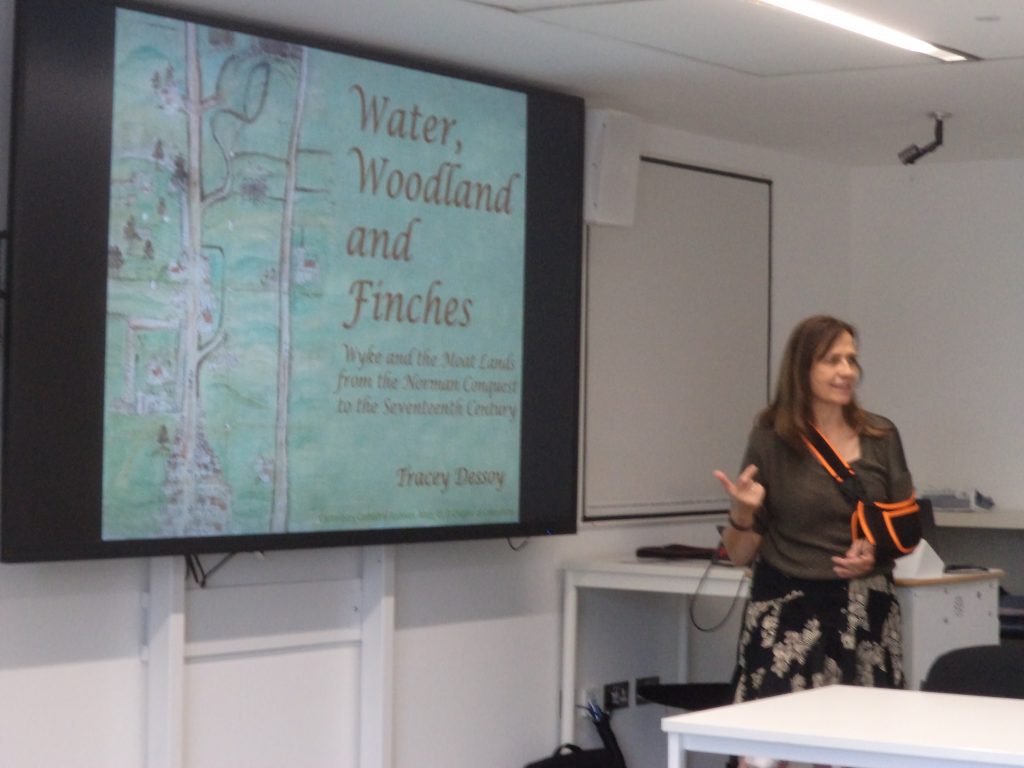
Thus, for this academic year I just want to finish with two talks, the first given yesterday (Wednesday 15 July) by Dr Tracey Dessoy to the Kent History Postgraduates group at Kent MEMS on her post-doctoral outreach and research work and my talk at Faversham on Monday. Tracey’s PhD is on the women of knightly families in Canterbury and its hinterland, with special regard to the 12th to 14th centuries. This meant she became very interested in tracing land holding and land use by women, and how the role of kinship, neighbours and communities, as well as the Church – from parish to archbishop, as well as the various religious houses intersected with the lives and responsibilities of these women. Linked to such matters, Tracey has also been very interested in landscape history – bringing together documents and archaeology – and Tracey has similarly pursued such lines of investigation since she graduated by joining forces with Keith Parfitt, the founder and leader of the Dover Archaeology Group.
Currently they have three projects in progress. The first relates to the manorial holdings linked to Old St Albans Court which was the home of Peter Hobbs and his family, and it still held by the family since Peter’s death. The Dover group have been working on the estate for years and, while they are no longer excavating, there still remains the importance of building on Peter’s own work in the archives to provide ideas about the development of a chronological survey of the manorial complex down through the centuries.
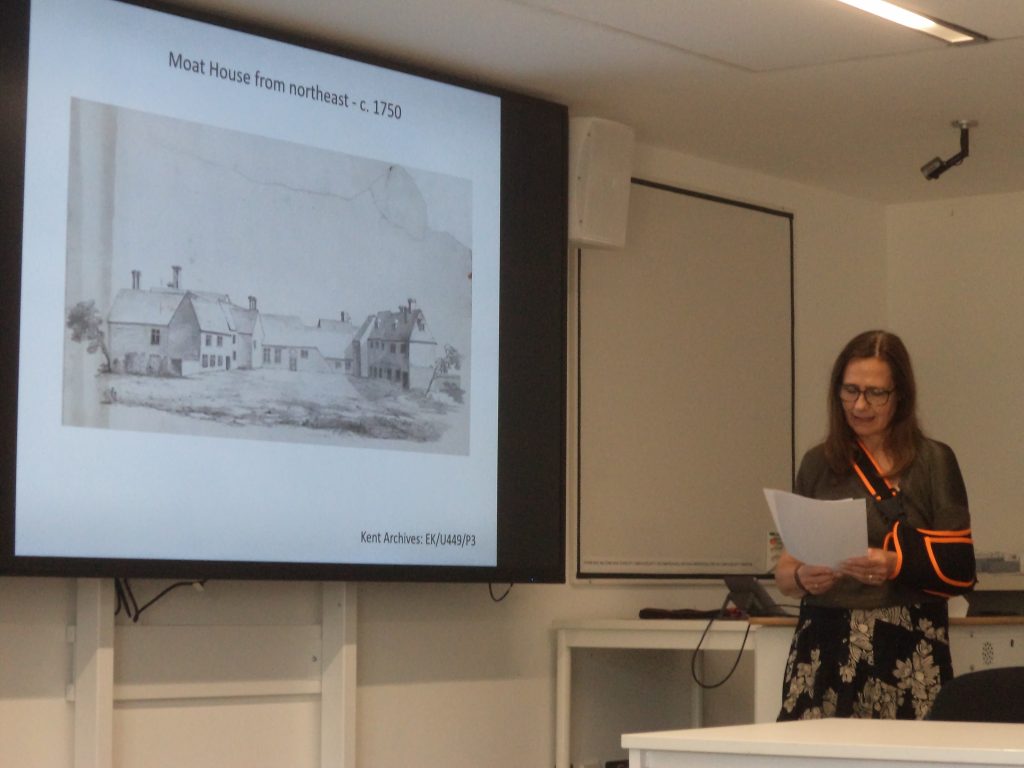
The second project concerns land associated with Lees Court near Faversham, a site Keith has been working on for several years as part of the community archaeology on Lady Sondes’ estate under the auspices of KAS. However, it was the third project that was the main topic of Tracey’s presentation. This dovetails with her doctoral research and the land being under threat of development for houses and infrastructure projects because it is located to the east of Canterbury and bordering Fordwich to the north. Consequently, Tracey took her audience – and it was great to see almost all of the group in the room – through the various families and owners of the land and manorial properties, as well as the associated lanes. This meant Tracey was able to use Elizabethan and Stuart maps, various surveys, rentals and other estate documents, as well as modern OS maps. Tracey has done some excellent detective work concerning Wyke, Moat and the other named holdings, and it will be interesting to see the end result when it is written up for publication, hopefully in Archaeologia Cantiana as that seems a sensible outlet. Moreover, it was clear that the other doctoral students had found the presentation interesting and there were a number of questions afterwards, especially over coffee. Thus, we have had an excellent series of presentations, and the group will reconvene in September.
Finally, on Monday this week, I gave a talk to the alumni of Queen Elizabeth Grammar School in Faversham to mark the 450th anniversary of the queen’s charter for the refounding of the school and the 500th anniversary of its predecessor, the grammar school founded by John Cole in 1526. As I said, there has been a considerable amount written on both schools, which meant I wanted to explore 4 aspects as a way of drawing the narrative together within the context of the developments in education at the time. Consequently, I explored evidence of early educational provision in Faversham; Cole’s school as part of the new educational ideas; an examination of what we know of about the impact of the Dissolution, and the rebirth of the grammar school through the queen’s charter, the new school building itself as well as how and why the 1576 school built on its predecessor.
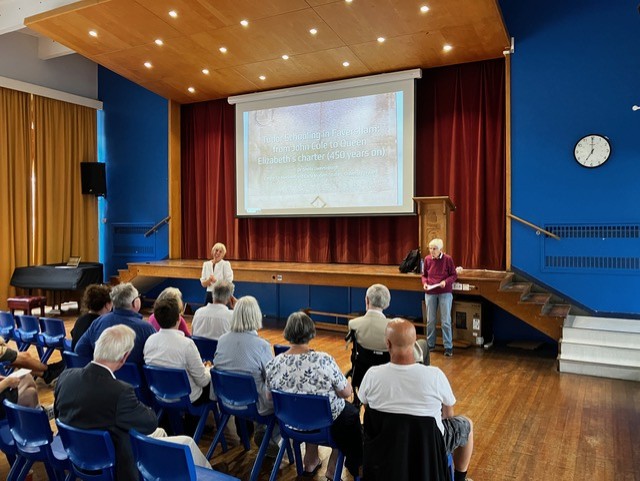
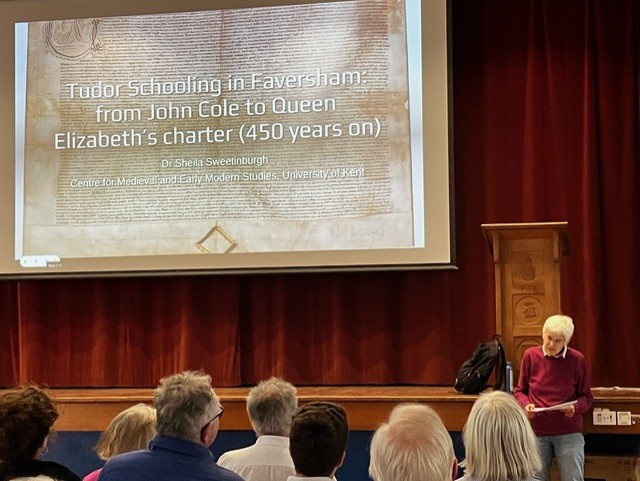
Hence, we looked at contemporary ideas about what constituted elementary and grammar schooling more broadly, as well as with specific reference to Kent. This meant we explored issues such as early Tudor chantries, the development of polyphonic singing, the significance of new humanist educational features, the desire for orthodoxy within this new world, the shift from singing to numeracy in terms of what should be taught, the very, very limited educational provision for girls, and just why and how education was valued.
All in all, the talk was well received with questions immediately after the presentation and then people who came up afterwards. Moreover, I was able to talk about the teaching and use of Latin and vernacular languages over time, as well as different ideas about the need to learn to read as opposed to writing. Consequently, it seems the school feels it has marked this anniversary in a very satisfactory way and hopefully will have many more such anniversaries in the future.
Categories
academic archaeology Blog Posts Canterbury Events Heritage Kent Lecture local and regional history Middle Ages News Stuarts TudorsHome
1 Comments
Terrific blog, I’m looking forward to the upcoming 15th C conference and the Nightingale Lecture – and more great blogs in the next academic year. Many thanks indeed