
From Miracle Tales to Medieval Feasts
An update on Tudors and Stuarts 2027, the programme is complete except for the last abstract which will be coming in any time now.
Just as an indicator of the great speakers, we have for you, on Friday 30 May our first presenter will be Dr Elizabeth Norton. She will explore how Elizabeth I was able to establish herself as monarch and to thrive in what was a man’s world. Then on the Sunday afternoon of 2 May, Professor Clare Jackson will provide an assessment of how James VI and I sought to create the British monarchy by joining the kingdoms of Scotland and England. And between these talks we are offering a rich programme of 18 presentations under the usual headings of ‘Royalty & Nobility’, ‘War & Politics’, ‘Religion & the Arts’, and ‘Social History’ which means, I think, there is something, indeed often several talks, for everyone! So please watch this space because with Ben Cornwell’s and Kieron Hoyle’s help, the hope is to have the ‘History Weekend’ website up by early November at the latest.
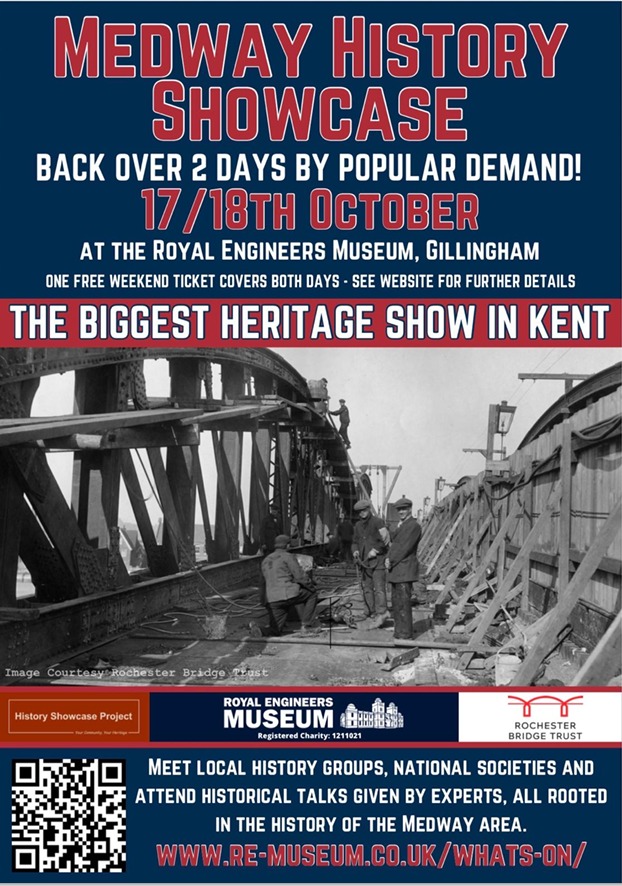
An event that will be taking place far soon, indeed this coming weekend is the Medway History Showcase 2026 brought to you by the organisers Peter and Jane Joyce. As before, it is being held at the Royal Engineers Museum, Gillingham and, as well as a programme of history talks on both days, including by Dr Jack Newman, Jason Mazzocchi and me, we at KCHH will have a stall to showcase our involvement in publishing on Kent’s medieval and Tudor history, as well as CAMEMS and Kent MEMS. So, if you are at the Medway History Showcase, do come and see us.
Then in November we will be at the Canterbury Expo on Saturday 28th at the Westgate Hall where again we’ll be highlighting our engagement in researching a broad range of topics regarding aspects of the county’s history. In addition, similarly we’ll have literature on CAMEMS and Medieval and Early Modern Studies (MEMS) at the University of Kent. For those in Canterbury, again please do come and see us.

Those are the main outreach events coming up, but I think it is also worth mentioning that this week I’ll be joining Jack Newman and others at Maidstone Museum for the next Maidstone VCH project meeting. Then later this month there are meetings for the Rother Levels wills group, a trustees meeting for Brook Rural Museum, a meeting of the Kent History Postgraduates for Amilia Gillies’ presentation, and the Kent MEMS programme of research seminars. Furthermore, this week has also included a CAMEMS trustees meeting, as well as one for Eastbridge Hospital trustees, and if you haven’t visited this fabulous medieval gem in Canterbury’s High Street, please do! It is now open daily between 11am and 3pm and most days there are guided tours available that you can join at no extra cost beyond the entrance fee.
Now the two events I want to feature in slightly more detail. These are first the ‘Celebration and Medieval Feast’ at the Maison Dieu in Dover last Saturday and then Professor Rachel Koopmans’ seminar presentation to the Kent MEMS community of staff, postgraduates and friends of the Centre. To start with the celebratory event to mark the successful conclusion of the ‘Reawakening the Maison Dieu’ project which involved the generous financial support of Dover District Council, the National Lottery Heritage Fund, Dover Town Council, the Wolfson Foundation and The Dover Society. Representatives from all of these were present on Saturday and, as master of ceremonies, Martin Crowther the Project Officer, welcomed representatives from the National Lottery to unveil the hand-stencilled roundel which commemorates this fantastic project (see below).
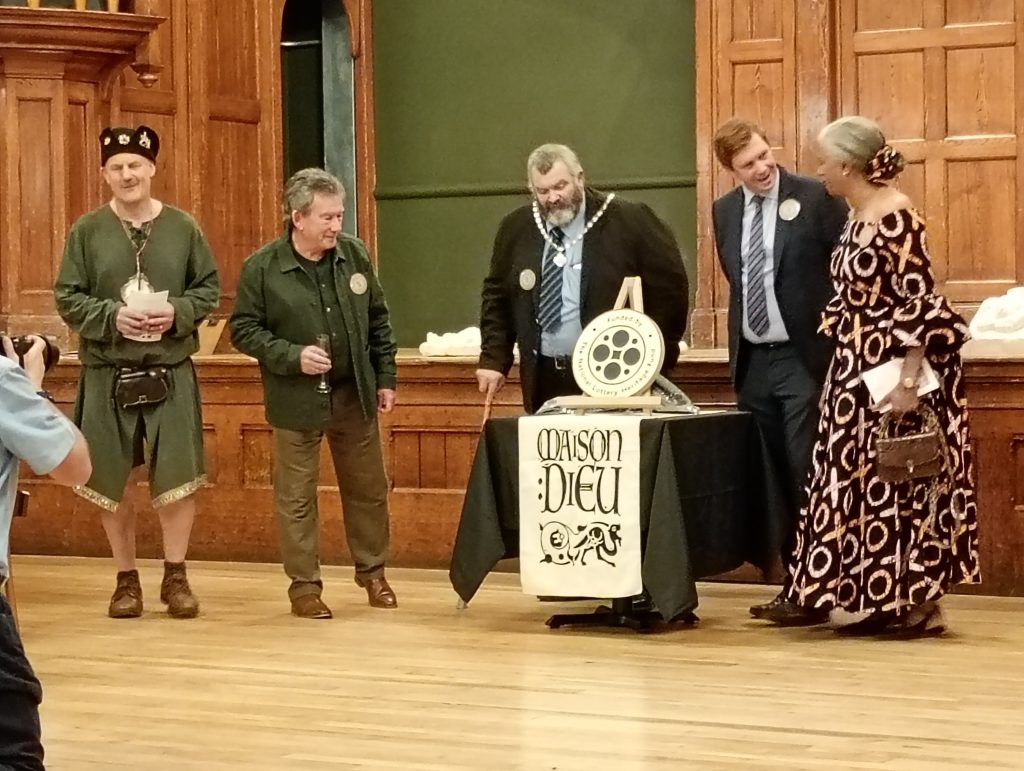
As Martin said in his introduction, the project has benefitted from the skills of many organisations, including Haverstock Architects, Ingham Pinnock Associates, Atelier, Coniston Ltd, Arte Conservation, Bainbridge Construction and Easthope Stained Glass. Moreover, community groups have been a cornerstone of this project through such things as the provision of workshops, conferences, displays, hands-on sessions, exhibition materials and engaging with the community of Dover and east Kent more broadly. It is not possible to mention everyone, but these include Artswork Dover, Future Foundry, Shiva Nova, Dover Big Local, the Positive View Foundation, The Samphire Project, Dover District Disability Association, Medieval Animals Heritage, The Maritime Kent project, The Cinque Ports Confederation and the many local schools, community groups and other partners, as well as the Maison Dieu Ambassadors and Friends.
Guests had first congregated in the spectacular Connaught Hall for these preliminaries and to hear medieval and other music beautifully played by Rough Musicke and Shiva Nova’s Orchestra from Everywhere, before we all trooped into the Stone Hall where there were 4 long tables. The feast comprised a 2-course medieval style buffet provided by Tayberry Foods, which was warmly appreciated by all concerned – as was evident from the lively conversation, enjoyable feasting and the empty plates afterwards.
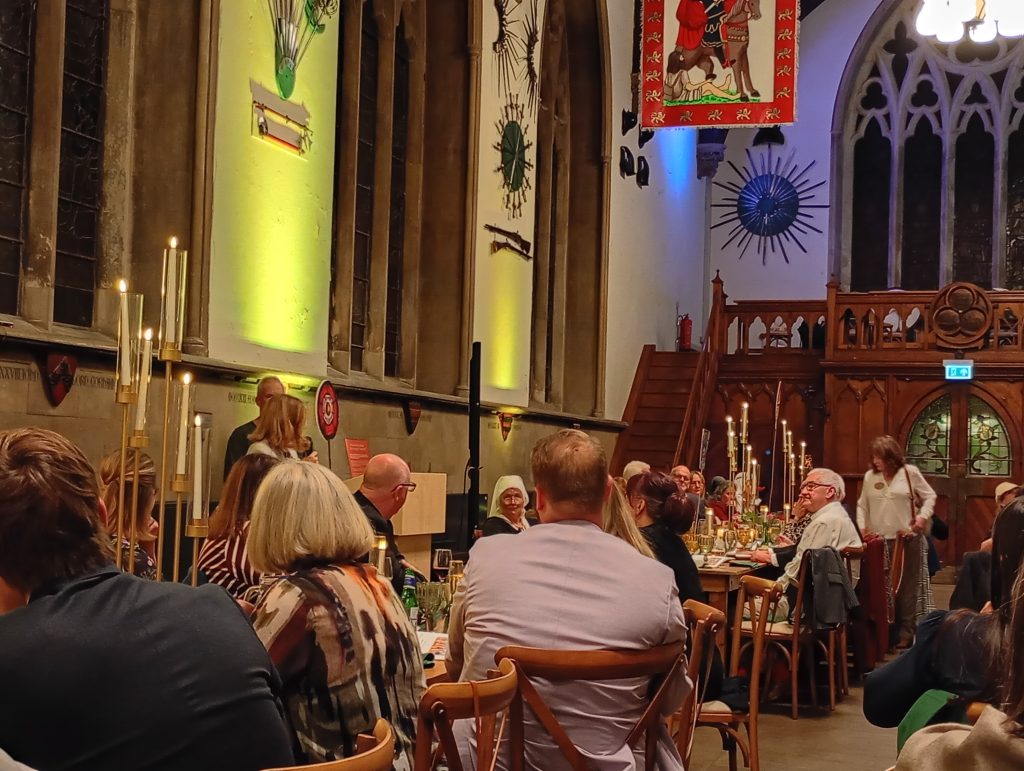
The guest of honour was the Lord Lieutenant of Kent, Lady Colgrain, and after the feast Martin introduced her to the assembled company to hear her speech where she graciously acknowledged what a fantastic project this had been in so many different ways – from the quality of the conservation and restoration to the wide-ranging engagement by professional organisations and volunteer groups of all ages. Thereafter, Rough Musicke returned to the stage in the Connaught Hall where Martin and some others enjoyed ‘medieval’ dancing – a fitting end to a great project that has saved this iconic Dover building and given it a potentially fantastic future!
Now to my second event, Rachel’s presentation to Kent MEMS on her research so far concerning three of the Becket Miracle Windows from the north side of Canterbury Cathedral’s Trinity Chapel, with the first from the south side now on the bench in the Glass Studio workshop. She began by providing an introduction to these windows as a set, what had been lost – 4 of the medieval windows ie 3 completely and one that is totally Victorian, which means bar one medieval panel that is in the United States, the 2 windows depicting Becket’s life have gone, possibly primarily during the destruction wrought of the Reformation when Henry VIII sought to obliterate Becket and any memory of him completely. Additionally, there were further iconoclasts at work in the mid 17th century, while environmental damage – combination of sun, wind and rain, is especially apparent on the south side. Finally, there are the actions of one of the window restorers, primarily in the early 20th century!
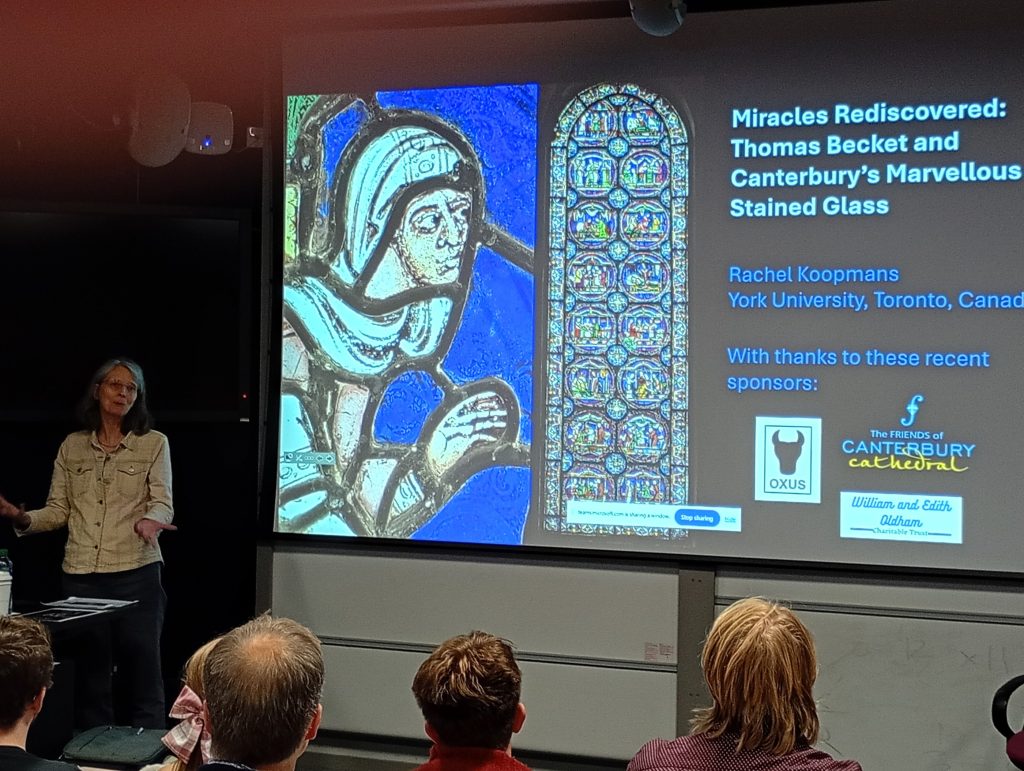
Nevertheless, as Rachel explained, there is still an amazing amount that has survived, and this is exceptional artwork, both in terms of the craftsmanship but also in terms of artistic and creative composition in that the late 12th and early 13th-century glaziers were imaginatively drawing on the miracle narratives collected by Benedict of Peterborough, with the later panels looking to the second miracle collection of William of Canterbury.
For her talk, Rachel had divided it into 5 questions, with a postscript at the end. As she said, unlike Madelaine Caviness who worked on her analysis with the glass in situ, Rachel has had the distinct advantage of having worked on it on the glaziers’ bench. Yes, this has been extremely costly, and Rachel acknowledged the marvelous support she has received from several funders, such as the Friends of Canterbury Cathedral, the William & Edith Oldham Charitable Trust, the Oxus Foundation and the British Museum, as well as most recently Madeline Caviness. Yet equally this new analysis has been exceedingly rewarding and fruitful, which means Rachel can now correct previous interpretations that in some cases has led to panels being relocated correctly, inscriptions brought back to life to make sense, and miracle recipients more securely identified.
Returning to Rachel’s 5 questions these were: a) going piece by piece in all the panels, which pieces of glass are medieval and which modern? This has allowed Rachel and Leonie Seliger to produce ‘charts’ of each panel showing just how much or how little is medieval, none of which are the same as Madeline’s, although this is probably hardly surprising bearing in mind the difficult conditions she was working under. Nonetheless, the work has revealed some extremely high-quality genuine medieval glass that is also shining a light on the story-telling sophistication of these early glaziers.
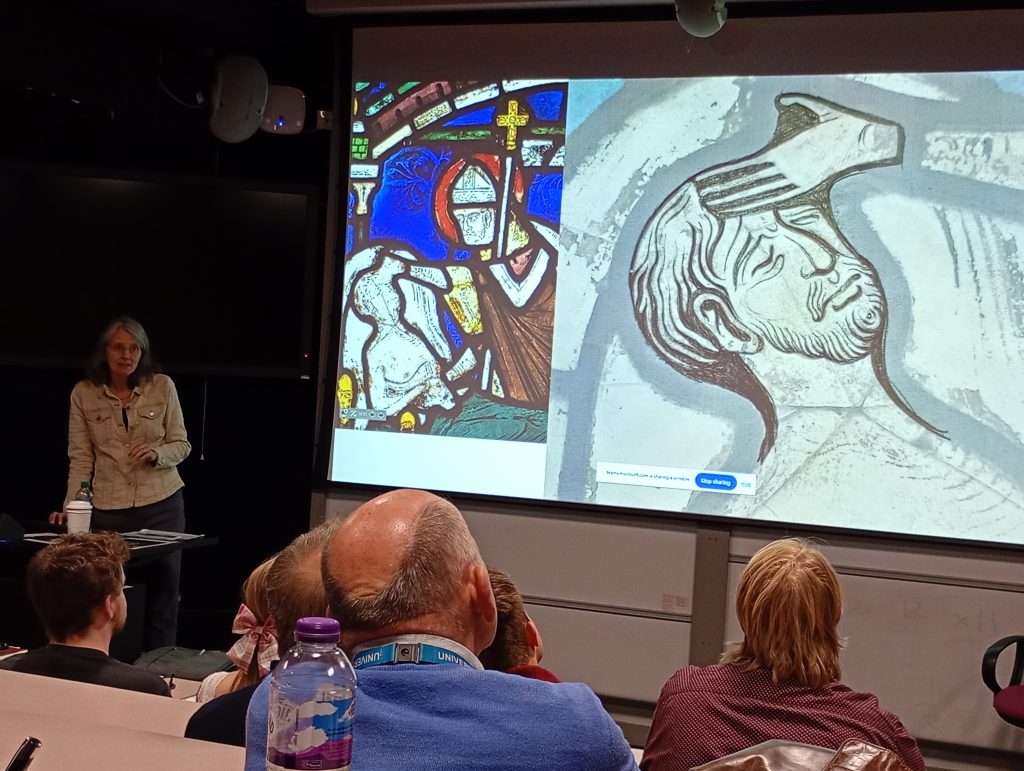
Question b) relates to finding ways to ‘recover’ what was there on those pieces that have suffered paint loss. Again, having it on the glaziers’ bench has been critical because by using raking light from a torch, the team has uncovered ‘lost’ words or parts of words from inscriptions, as well as delicate features such as those on faces. For Rachel, bringing both of these aspects back to life has been especially fulfilling because it has helped make sense in terms of identifying certain miracles and thus the compositional arrangement of whole windows. Moreover, the delicate nature of these facial expressions has illuminated the quality of the glaziers’ art.
Question c) in some ways follows on because correctly identifying the miracles portrayed is of paramount importance, as is showing just how close the glaziers followed their brief as taken from Benedict’s miracle collection. Added to this are ideas from the glass concerning such matters as how the glaziers’ portrayed movement either within Canterbury or leaving/entering the city, as well as offering ideas about the lives of ordinary people, the main recipients of these miracles.
Question d) looked at the work of the restorers, such as George Austin jnr in the late Victorian period who was a careful, highly skilled glazier, and his early 20th century successor Samuel Caldwell jnr who seems to have been given a very free hand that he apparently used to his own advantage, hence the sale of the panel to a buyer in the States (see above). Thus, there is a stark difference between the two men, Austin was not seeking to fool people, Caldwell was using glass pieces that he had mixed and matched and which he had faked in terms of aging and corrosion. Madeline was the first to identify some of Caldwell’s activities, but Rachel and Leonie have found more examples.
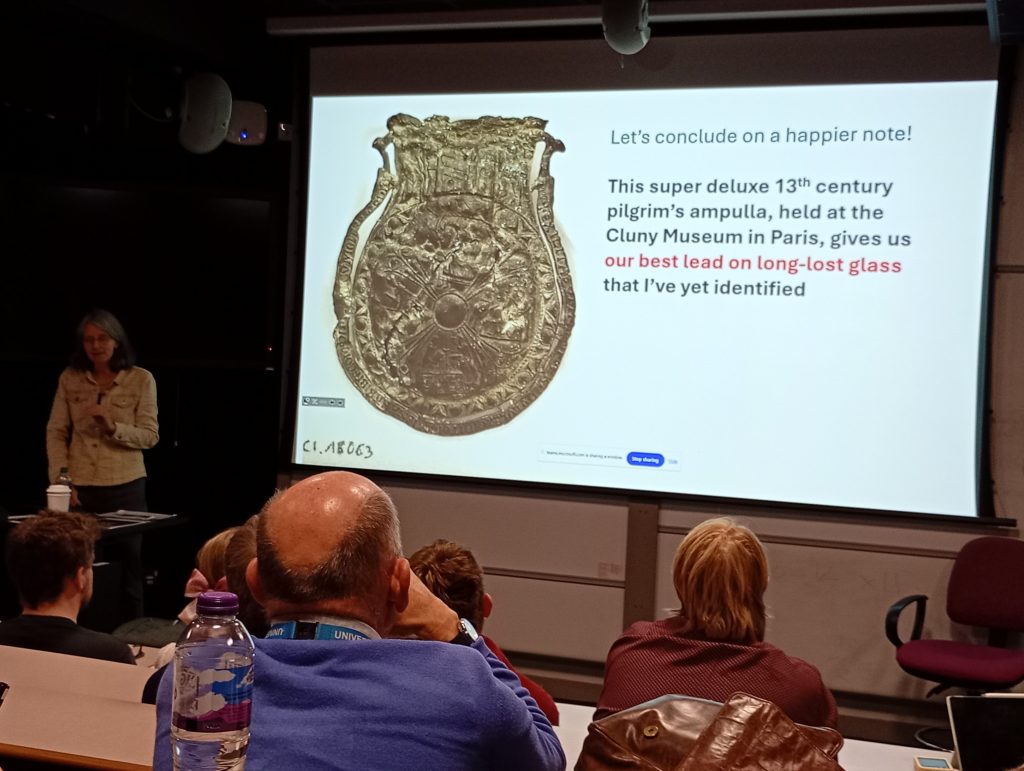
This brings me to the last question that concerns making corrections of glaring restoration errors. To help with this, Rachel in part has used a set of First World War I photographs of the windows. Additionally, the work on the inscriptions has been a gamechanger, and finding two inscriptions on a very high-quality early ampulla from the Cluny Museum in Paris has similarly aided work on two miracles, of which only one survives in relation to the actual portrayal of the miracle in the glass.
As you can see it was a fascinating session and the book for the ‘Kent window’ has now gone to press and should be in the cathedral gift shop by early December at the latest, a great result as Rachel now turns her full attention to the window on the south side. And as a final comment, she and Leonie have already made some discoveries, so watch this space! Indeed, if you would like to find out more concerning these ongoing research projects, Rachel and Leonie have organised a study day at the Cathedral on 10 November and the link has now gone live with the regular cost being £95, student rate £45: https://www.canterbury-cathedral.org/whats-on/events/10nov26-lost-and-found-hidden-histories-of-canterbury-s-stained-glass So do join them because this includes a visit to the Glass Studio.
Categories
academic Blog Posts Canterbury Events festival Heritage Kent Lecture local and regional history Middle Ages News Stuarts TudorsBack