
Forthcoming history events and Canterbury choughs
I guess for many the August Bank Holiday still denotes the end of one academic year before moving into the next, which at the University of Kent, as indeed for the University of Greenwich, marks a new chapter in the histories of these institutions.
However, leaving such matters aside, it is great to mention that next week the Fifteenth Century conference will be coming to Canterbury. Consequently, in addition to a programme of what promise to be fascinating papers, Dr David Rundle and I as organisers, with the considerable assistance of Jan North in the conference office, are working with colleagues in the city at Canterbury Cathedral and Eastbridge Hospital. In conjunction with Cressida Williams at the Cathedral Archives, we have a special display of archival materials, will hold one of the conference sessions within the precincts, will have a tour of the late medieval city and have a special visit to the medieval hospital of St Thomas the Martyr.
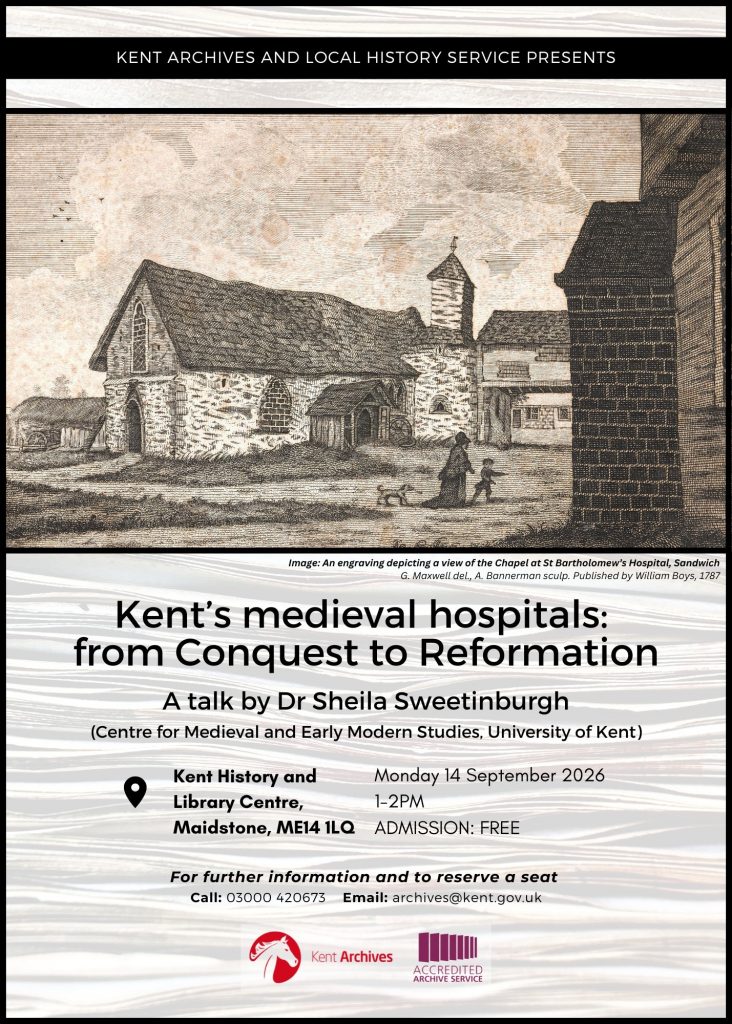
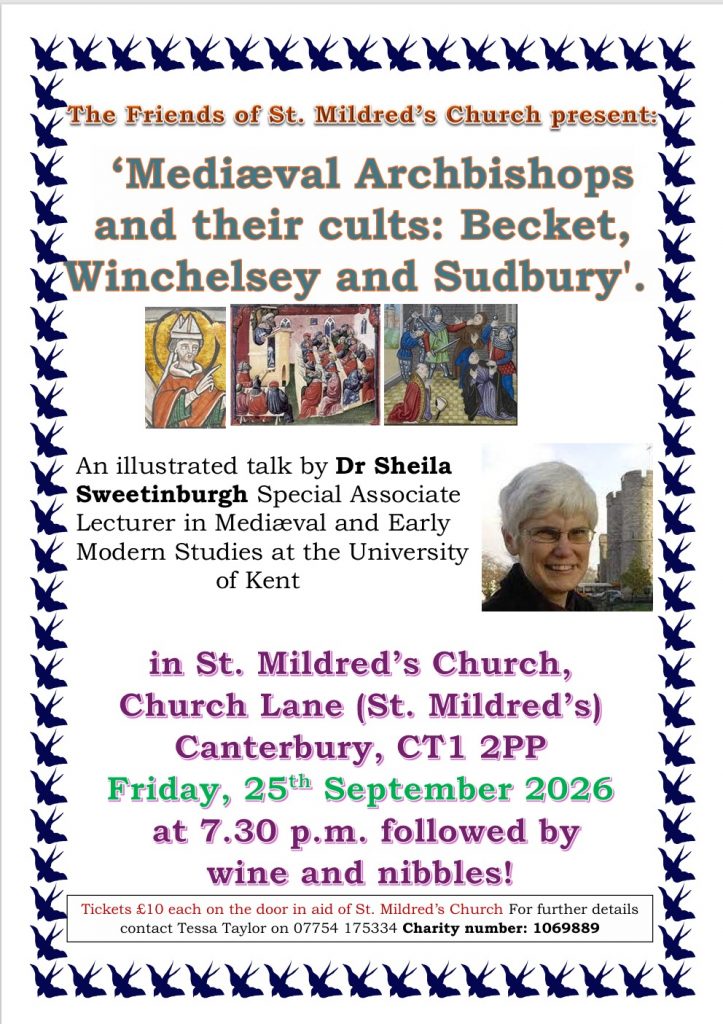
Keeping with medieval Canterbury and hospitals, albeit looking beyond the city to include other fascinating institutions, I thought I would flag up again later dates in September for these two talks as they are both for good causes. Firstly, the next Kent Archives lunchtime talk will be on Monday 14 September at 1pm at the Kent Library and Archives Centre in Maidstone on ‘Kent’s Medieval Hospitals: from Conquest to Reformation’. These talks are free but you need to book by either emailing: [email protected] or phoning 03000 420673, Then on Friday 25 September for the Friends of St Mildred’s Church in Canterbury, I’ll be speaking at the church at 7.30pm on ‘Medieval Archbishops and their cults: Becket, Winchelsey and Sudbury’. This will be in aid of church funds and tickets will be available on the door. Moreover, if you haven’t seen the interior of this brilliant medieval church and its stunning 14th-century roof timbers, this will be an excellent opportunity!
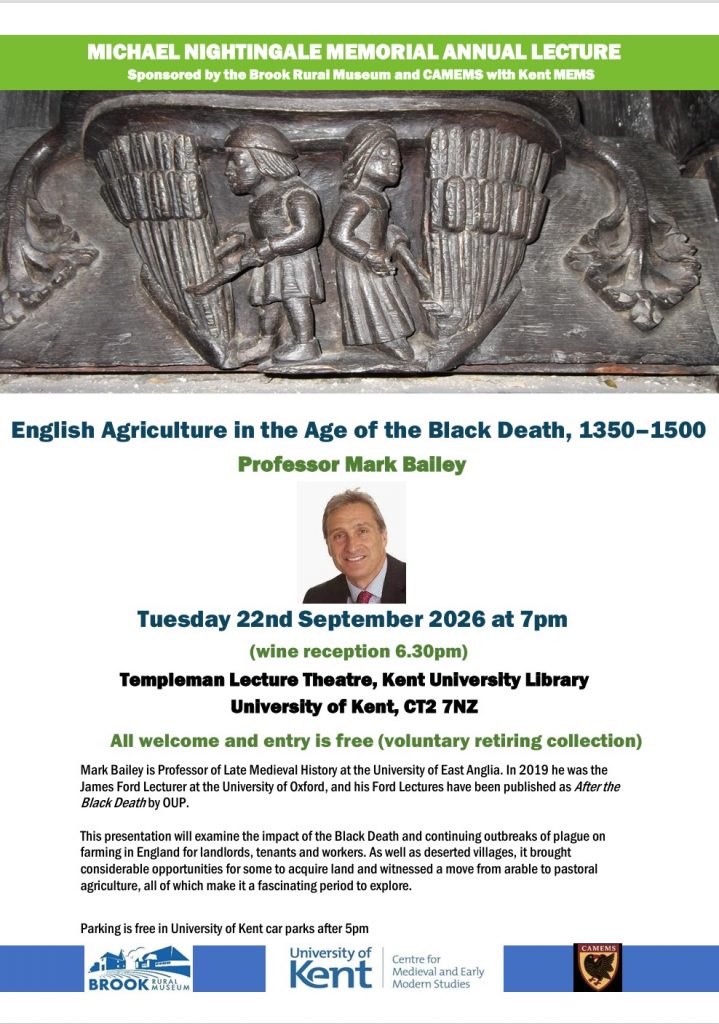
Another date for your diary is Tuesday 22 September. Organised under Kent MEMS, in association with CAMEMS and Brook Rural Museum the annual Michael Nightingale Memorial Lecture which will take place on Tuesday 22 September in the Templeman Lecture Theatre, University of Kent at 7pm (wine reception from 6.30pm). Our speaker will be Professor Mark Bailey (UEA) and he will be discussing ‘English Agriculture in the Age of the Black Death, 1350–1500’. All are welcome, and the lecture is free, booking not required, and there will be a retiring collection in aid of the Museum and CAMEMS. Some of you may remember the excellent lecture Mark gave in 2024 at the Canterbury Medieval Weekend that year, hence it brilliant that he is coming back again, so please do come along if you can.
The Kent History Postgraduates group will again be meeting in September, and the other members are looking forward to John Manley’s presentation. There will be more on that in due course. Additionally, I’m hoping to be able to provide information on other history developments before too long, do watch this space!
What I would appreciate you doing in the meantime is putting the dates for the Tudors and Stuarts History Weekend 2027 in your diaries because it will take place from the evening of Friday 30th April to the mid afternoon of Sunday 2nd May 2027. I already have some brilliant speakers in the programme, and I hope to have the whole programme sorted by the end of September.
Hopefully, too, many of you will remember the Medway History Showcase 2025 as well as preceding years. Well, the Medway History Showcase 2026 will be back on 17th and 18th October at the Royal Engineers Museum, Gillingham! Currently the programme isn’t up but hopefully will be soon at: Medway History Showcase 2026 | Kent Attractions and as before is organised by Peter and Jane Joyce with the Museum. Among the speakers will be Jason Mazzocchi and me.
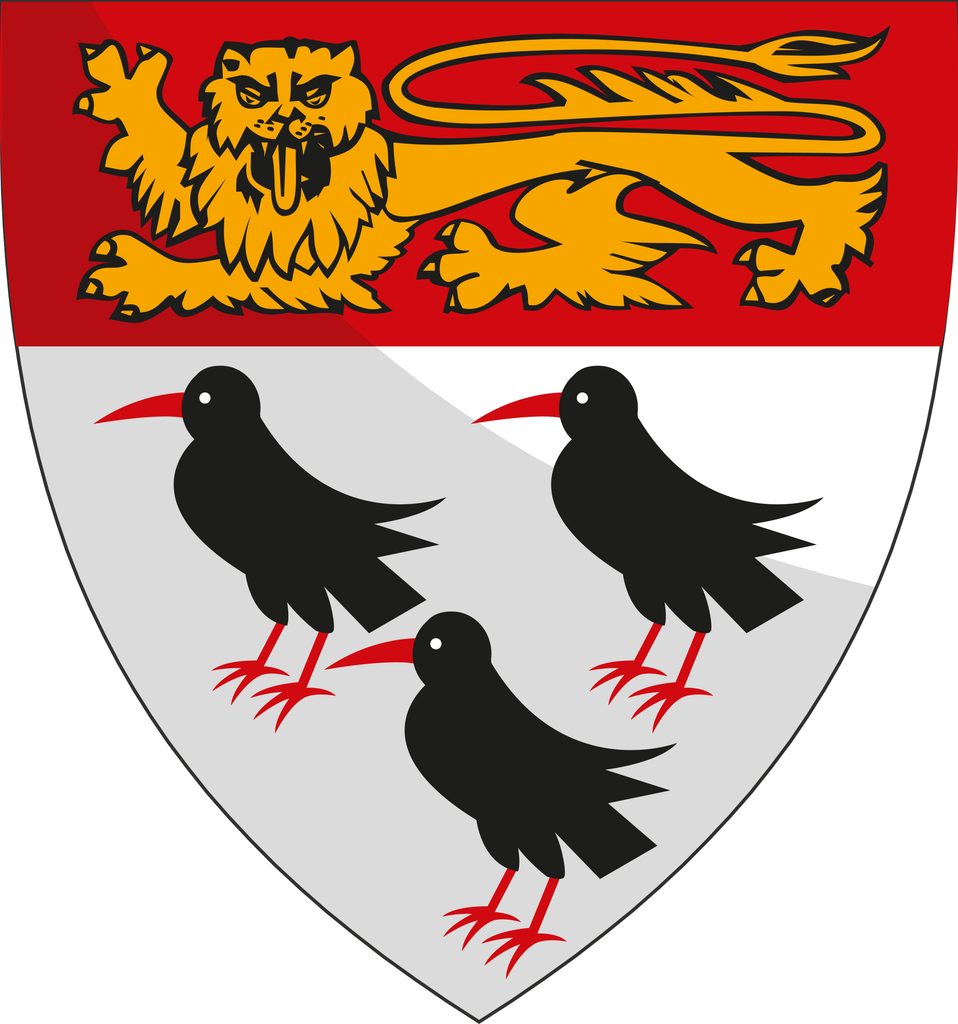
To finish with a little history, which hopefully will be of interest. I was looking through Duncan Harrington’s ‘Collections for a History of Faversham Abbey’ and I was struck by a document he had found which mentions ‘choughs’. These days the chough, as we now know it, is largely associated with Cornwall since its recent re-introduction to the county from Ireland, albeit there are such choughs in north-west Wales and similar coastal areas in western Scotland and there is a new breeding programme at Wildwood, Blean, which has led to them being successfully re-introduced to the cliffs east of Dover. Nevertheless, it is worth noting that by the 15th century the association between Cornwall and this red-legged chough was well established – see the reference to an inn called The Cornysh Chogh in St Dunstan’s to the north-west of Canterbury in a will of the period. This inn, of course, also highlighted the Becket link – the red-legged choughs as ‘Becket birds’ and still to be seen on the badge of the City of Canterbury for that reason. But, and it’s quite a big ‘but’, in the 16th century (and earlier) the word ‘chough’ referred to jackdaws which were seen as pests, and this brings me to Duncan’s document. In a letter within the Letters and Papers of Henry VIII, there is one that Abbot John sent to Cromwell where he complained that “Our convent has granted to Mr. Hungerforth 3l. annually, according to your desire, as held by the late Sir John Norton. As you have always promised to us a continuance of your favor to remedy any complaint, understand that I am marvellously annoyed with rooks, crows, choughs, and buzzards, which not only destroy my doves but the fruit of my orchard. I desire licence for my servants to have handguns and crossbows to destroy the said ravenous fowls. Faversham, 20 Feb. 1532” In what might be called a ‘sweetener’, the abbot had “Before the last Feast of All Saints I sent the King a goshawk of two cotes and a couple of spaniels. There are few better in England for pheasant and partridge. They were received by Sir Nich. Carew.” In case you want to see it, herewith at: Henry VIII: February 1532, 16-28 | British History Online
Categories
academic Blog Posts Canterbury conference Events Heritage Kent Lecture local and regional history Middle Ages News Stuarts TudorsBack