
Catherine Richardson’s Renaissance Lecture
For this week, Jason Mazzocchi has kindly provided a report on Professor Catherine Richardson’s Renaissance Lecture which took place on Thursday 21 May. Unfortunately, I had to miss it because that evening I was speaking to the Bridge and District LHS on migration in Canterbury and Kent during the 15th century, albeit they were a great audience with lots of interesting questions.
However, before the report, I want to flag up a couple of forthcoming talks in east Kent. Next Wednesday 27 May I’ll be giving a talk to the Sandwich Local History Society at the Guildhall, Sandwich, beginning at 7pm on ‘The ‘lost’ St Bartholomew’s Day Procession of 1532: an exploration of discord in Henrician Sandwich’, please see CAMEMS: The ‘lost’ St Bartholomew’s Day Procession of 1532 – CAMEMS, Canterbury as all welcome, non-members £5. Then on Thursday 11 June Jason Mazzocchi will be speaking to the Faversham Society at the Faversham Assembly Rooms at 7.30pm. For further details, including how to book, please see: Events – The Faversham Society .
Looking to further events next month, MEMS Fest, which is a celebration of Medieval and Early Modern Studies at the University of Kent, will be on Friday 19th and Saturday 20th June and is free. This is the website for booking: Medieval & Early Modern Studies Festival 2026 – A celebration of research in the Medieval and Early Modern periods at the University of Kent .
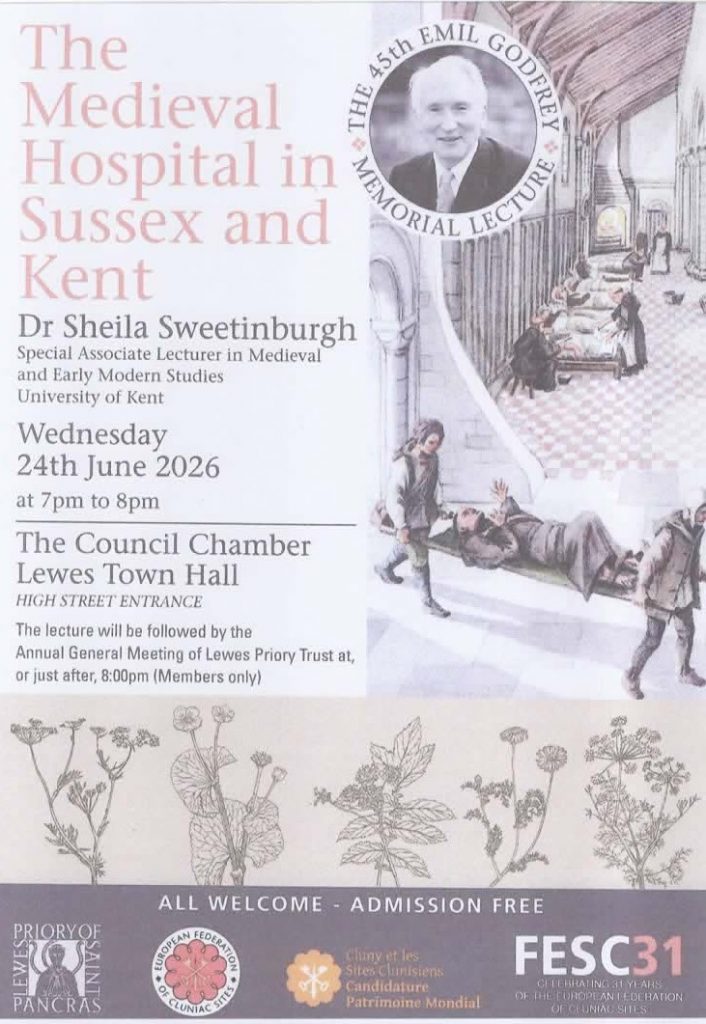
The following week has the Cinque Ports conference on Friday 26th and Saturday 27th June at the Maison Dieu in Dover. For the full programme and booking, please see: Cinque Ports Conference | UK Talk/Panel Discussion Reviews | DesignMyNight while on the Wednesday (24th June) I’ll be over the county boundary at Lewes to give the annual Emil Godfrey Memorial Lecture for the Lewes Priory Trust on ‘The Medieval Hospital in Sussex and Kent’ at The Council Chamber, Lewes Town Hall at 7pm, free and all welcome.
Now I want to turn to Jason’s report. The title of Catherine’s Renaissance Lecture was ‘Understanding the Culture of Early Modern England: Middling Status, creativity and practice’ and she began by introducing the project team, the project having started during lockdown at <https://middlingculture.com>. The idea is to explore the cultural lives of the literary, urban middling sort in early modern England 1560–1660. The focus is on the households of professional tradesmen and urban administrators (and their wives and children) and how reading and writing fitted into everyday life as creative practice.
She then went on to introduce the middling sort: they were workers from independent trading households (not wage labourers), a group with economic, political and cultural capital within their communities, including some who at times held ecclesiastical office. The research has concentrated on provincial urban communities outside London, including Canterbury, Chester, Stratford, Bristol, and Ipswich. The focus on place is important because it provides an understanding this group’s collective investment in space and in a sense of belonging and pride.
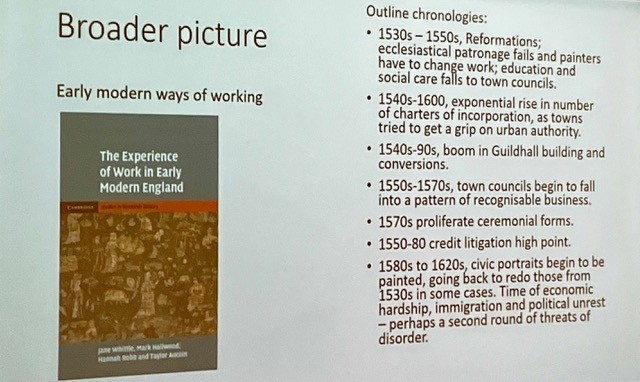
Catherine then raised the question what the middling sort did – in relation to work, and what work took place across different spaces. An expanding middling sort could be located in a commercial context and the creative industries; they shared similarities but also divided into different groups. Their everyday lives were about doing – getting things done in civic and religious life in the urban space, and as a community.
She sees the middling sort from 1570 – 1620 as a recognisable economic and social group who, through the proliferation of ceremonial forms especially as members of their respective civic authorities, they acted as a group who were ‘doing things together’ (for instance, embodied in the development of the guildhall). It was also the age of civic litigation – ‘credit working for you’ – and at the time important because the end of the 16th century was characterised by a period of crop failures and famine, economic hardship, immigration and political unrest.
Other aspects of this society that Catherine and Tara Hamlin have been exploring are the development of new types of cloth, as well as how such textiles were used because the material culture of the middling sort is a key component of the project. For example, they discovered that between 1560-1630, 45% of inventories mention at least one cushion (a feature of this middling group and a part of the domestic culture of ornaments). The types of material used were seen by contemporaries as important markers of status, as were their placement in certain rooms, and cushions are similarly bequeathed in wills, thereby highlighting their cultural and material value. Furthermore, the textile as ornament had differing functions in the domestic sphere, reflected through such matters as place of origin as well as the type of cloth – the value placed on imported materials, as well as craftsmanship and the production of unique individual items. This has brought in the concept of fashion for the project team, such as the decline in carpets during the period and an increase in smaller amounts of cloth being recycled into objects of the middling-sort aesthetic. These are beginning to emerge, for example, as guildhall and church cushions and the decoration increased with the move to a preaching culture, acting as authority, status and ‘showing off’ – a cultural materialism performing an ideological function and emergent sets of representations.
The value placed on the cushion in civic space is also supported by the role of civic dress as performance. Civic dress in the form of specific gowns signifying occupational office and different from ‘best clothes’ were also bequeathed to sons and nephews, thereby highlighting the role of family and dynasty for this group. For, as Catherine said, such wearing signifies occupational office and hierarchy – transforming laymen into civic authority – the gravitas of authority which is important at a time of crisis for the urban space. This relationship between office and dress is political and ceremonial – it is ordering and authority over the civic space by the middling sort, developments that have their roots in late medieval culture. Furthermore, these gowns are increasingly displayed in portraits of such civic office holders – as a way of seeing and acts as performance – reinforcing civic authority through piety and death (see photo).

Catherine then summarised the wider material culture represented in portraits, such as how the mace elevates the importance of the individual shown, as well as the status of the urban community he can be seen to represent. Moreover, the portraits are in the public domain, as objects which are moved around and displayed, thereby complementing the role of civic dress employed in performance during processions, a reminder of the power and civic hierarchy (coinciding with the building of guildhalls and symbolising the place of civic authority and a group identity). Nevertheless, these individuals are equally in direct competition with each other for they represent inter–dynamic relationships, or a middling status, signifying collective and commercial development. To strengthen their position, these urban elites use local community artists and craftsmen, a form of self-perpetuation whereby the middling sort develop their own practices generating urban identities through the ceremonial.
As a consequence of such a rich and thought-provoking paper, Catherine received a warm round of applause for her Renaissance Lecture from a very appreciative audience. She then addressed a robust set of questions on the middling status of early Modern England before the audience enjoyed a wine reception sponsored by CAMEMS, a good conclusion to an excellent occasion.
Categories
academic Blog Posts Canterbury conference Events Heritage Kent Lecture local and regional history Middle Ages News Stuarts TudorsBack