
Medieval Kent – shipbuilding, coins and the Canterbury Blackfriars
For the last two weeks of February, I have several events to report on involving Canterbury and Kent’s history that I hope will be of interest. These are shipbuilding in the late medieval Cinque Ports, the Canterbury ‘Blackfriars’ through the ages, and medieval coin hoards found in Kent.
However, first I just thought it would be worth mentioning that this fortnight has included a meeting of the Lossenham wills group where we heard about Sue and Celia’s visit to Cambridge to meet Professor Clare Jackson to discuss the imagery on the Tenterden charter copies in the Custumal book. Additionally, I was at two other meetings recently. The first was a trustees meeting of Brook Rural Museum where we discussed potentially new and exciting plans, and although not as far down that track yet, the second meeting at Eastbridge Hospital was similarly again on the potential to give it a secure future as a key aspect of the city’s history and heritage.
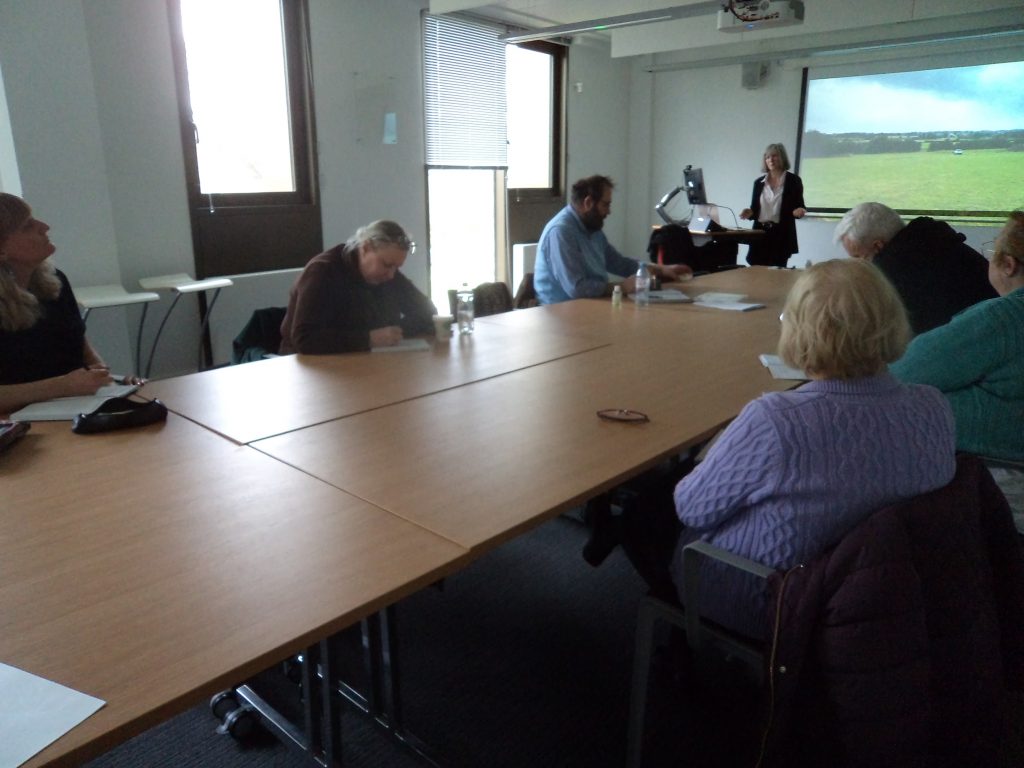
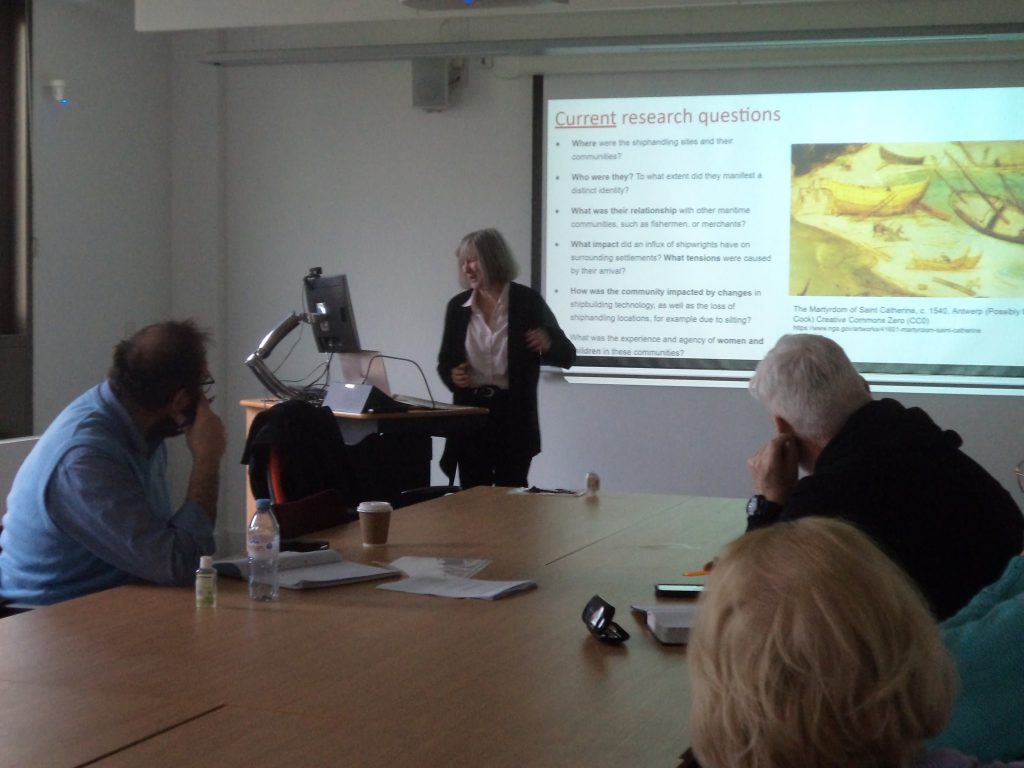
I think the best approach for my three reports on events is to work chronologically, hence my first is Angela Broomfield’s presentation to the Kent History Postgraduates group on Wednesday the 18th. Angela started her doctoral research last September on the shipbuilding communities of the Cinque Ports during the Middle Ages. Her interest in this topic grew out of her archaeological work over three digging seasons at Smallhythe to the south of Tenterden and on the banks of the river Rother. Consequently, as she said in her introductory section, her PhD is interdisciplinary because she will be drawing on both archaeological and documentary evidence for her various case studies, the first being Smallhythe.
Moreover, she is especially interested in the changes concerning ship building techniques employed in the later Middle Ages as a response to the demand for larger trading vessels. For in addition to the need to move greater quantities of goods, there were demands placed on these skilled workers to provide ships capable of carrying guns as part of a fighting force on the seas. All of these factors led to different uses of iron fittings, and Angela is looking at such finds from several coastal excavations associated with Kent’s maritime communities.
As everyone agreed at the end of her presentation, this looks as though it is going to be a fascinating thesis and there were a considerable number of comments and questions afterwards. Indeed, the discussion continued over coffee afterwards because, as was noted, the idea of exploring how maritime and allied communities responded to changing circumstances, whether political, economic, religious and/or social, is pertinent to everyone in the group, albeit time and place in Kent vary considerably.
The theme of changing circumstances and how communities respond – the tensions, losses, but also the gains – could be seen to have permeated through the three talks on the Canterbury Blackfriars through the Ages which took place the following (Thursday) evening. A full house of almost a hundred people arrived to enjoy a glass of wine provided by the St Peter’s Residents Association, who had organised the event and then everyone settled down for the talks.
I gave the first on the history of the Dominican friary, from the first arrival of these friars into England in 1221, albeit having landed at Dover and travelled north to Canterbury, they didn’t settle but continued on to Oxford and in was over a decade later in 1236 that a group returned to establish a friary. Although benefitting from archiepiscopal largesse, the friars’ primary benefactor and patron was Henry III, who gave them various donations towards the establishing of their church and to a lesser degree their conventual buildings.
Consolidation of their position in Canterbury in the 14th century was my second section, which they achieved with further royal assistance, as well as some gifts from local citizens. Generally speaking, the friars were successful in this increasingly congested spiritual economy, although as you would expect there were occasional tensions, as with the abbot of St Augustine’s and his mill nearby.
However, for the purposes of this talk, I concentrated on the later Middle Ages because even though the records from the friary do not survive, evidence can be found in the good collection of wills for Canterbury. These show that the friars were seen as valuable spiritual advocates for a goodly number of local people concerning burial at the friary, spiritual services linked to death and burial, as well as services beyond these. Just as an example, John Hogham, in 1482, stated that he wished to be buried at St Martin’s, where he was a parishioner, and that he wanted a Dominican friar to celebrate masses for his soul at the principal feasts for 5 years after his death.
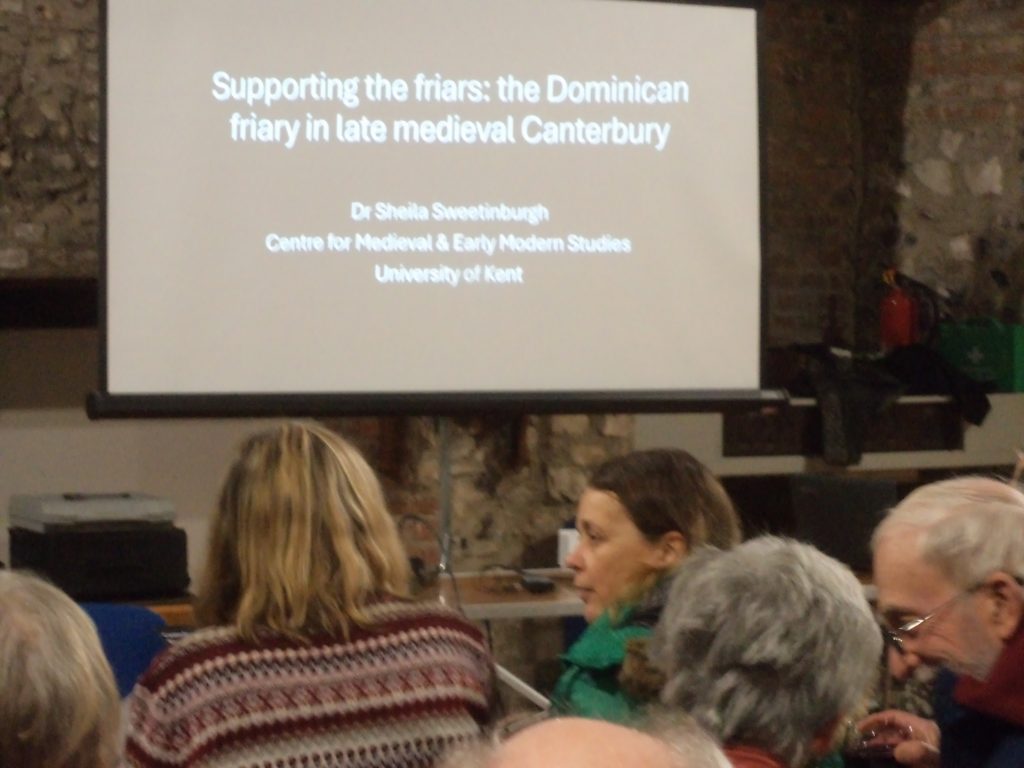
Nor were these the only inter-relationships between the Dominicans and those in Canterbury, because I also explored bequests made towards the friary buildings – Agnes Baker (1464) intended that after her husband’s death her tenement should be sold with some of the money going towards repairing the friary church. Secondly, bequests made for the benefit of the friars as a community – John Fisshe (1515) bequeathed a kilderkin of single beer to the friars, while William Gotley (1501) intended the prior there should receive an ell of white kersey cloth. The fraternity of St Nicholas at the Dominicans’ church was well supported and while most testators bequeathed sums of money, a half mark (6s8d) being the most common sum, Agnes Whitlocke (1491) was exceptional in her gift of her great mazer. Two other members of the family similarly supported this fraternity in their wills, John in 1503 seeking the closest relationship because he wanted members of the fraternity to bear him to the church for burial and he wanted his name to be added to the fraternity’s bederoll, for which he gave 10s.
To finish this section, I noted that during this period the friars seemingly remained on good terms with the city’s other religious houses. For example, borrowing from Merial Connor’s translation of John Stone’s chronicle, the Dominicans were involved in a Rogation procession on 29 May 1439. This started at the cathedral and made its way to the Dominican church (via the churches at Burgate, Newingate and All Saints) where a Mass for peace, for good weather and for other matters was celebrated, being accompanied by a Christ Church monk preaching a sermon in the Dominican friary’s churchyard before the monks returned to the cathedral.
Yet the mid-1530s brought change and the writing was on the wall! This meant that in December 1538 the Dominican friars surrendered their house to the bishop of Dover and thus after 300 years as part of the city’s spiritual landscape, the Dominicans, like the city’s 2 other friaries, were gone. Consequently, at this point I handed the baton to Professor Jackie Eales to continue the story.
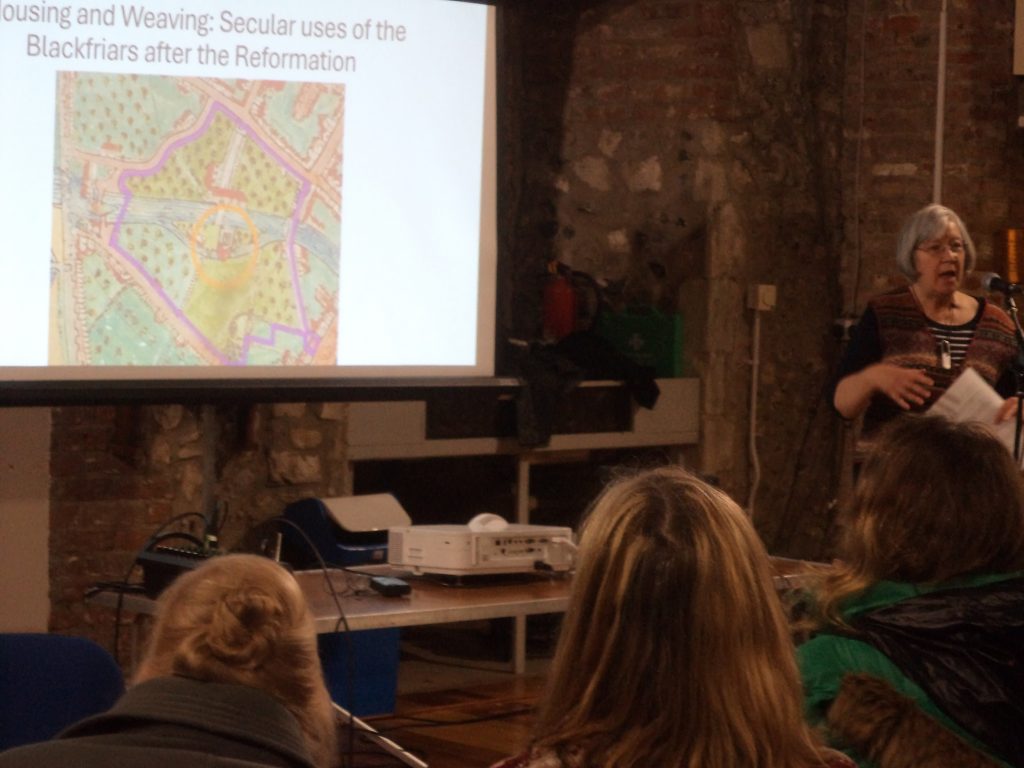
Jackie explored the history of the post-Dissolution site, especially the importance of the Blackfriars hall as a cloth hall for the late 16th-century Stranger community who settled in Canterbury and who revitalised the city’s cloth industry through the production of the lighter ‘New Draperies’. She also discussed John Bathurst’s use of the Blackfriars as a weaving shed, and then his sale of the place to the Hovenden family.
This brought her on to the dispute in the 1590s between the Hovenden family and the city authorities about the right of way from the friary gate on the High Street through to the site of what had been the friary church. This dispute resulted in violence, a court case in Star Chamber and ultimately the triumph of the citizens over the Hovendens.
Moving on in time, Jackie next discussed how the Blackfriars had come into the hands of a Flemish family in the 17th century. This immigrant family comprised three generations of surgeons, and amongst their other achievements, they built a great house on the site. Nevertheless, when the Blackfriars was inherited by Sir Egerton Brydges (through marriage) he had the mansion house pulled down as part of a bit of new town planning (he wanted a new street on the site of the old garden).
Nevertheless, two Blackfriars buildings survived, the guest house as a residence, including that of Major Cyprian Rondeau Bunce 1752-1907, before becoming a furniture store in the 20th century and finally bought by the Beerlings, today used by the King’s School. The other, the refectory, also went through several changes including a place of worship for the Anabaptists and then the Unitarians, as the premises of an antiques dealer, a place for the Christian Scientists courtesy of Lady Astor, and today it too is used by the King’s School.
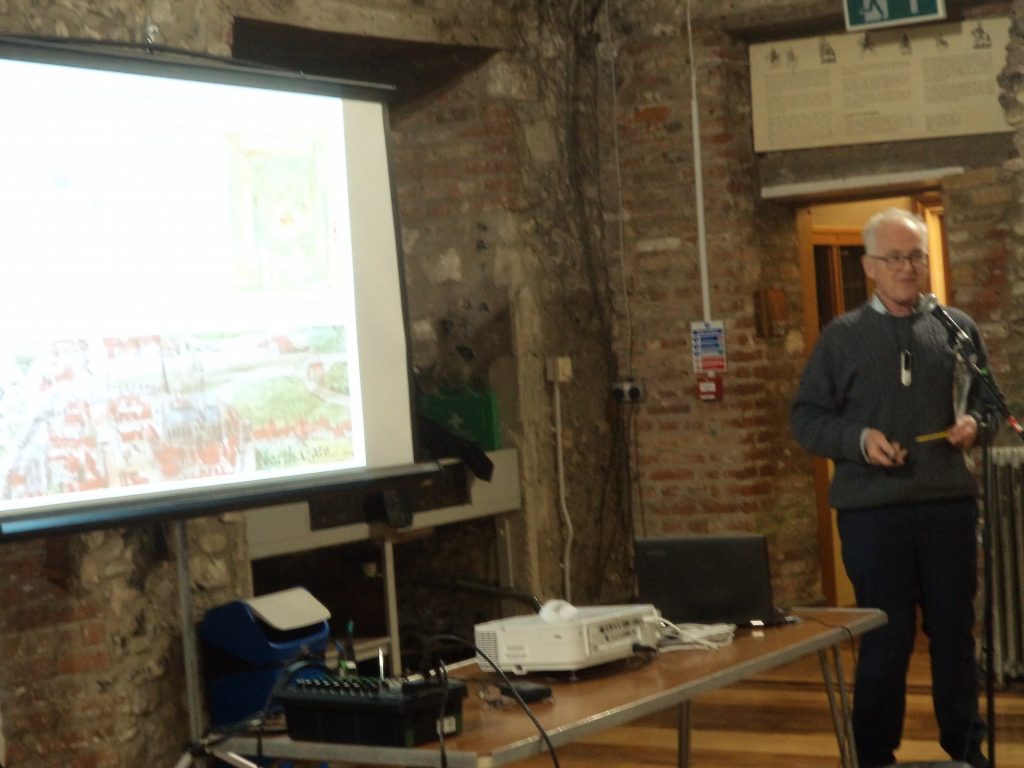
Having brought the audience up-to-date, Jackie handed the baton to Clive Bowley for the third talk. He, too, looked at the post-Dissolution Blackfriars site and provided several maps and plans from the 16th century onwards to illustrate how things had changed over the centuries. Additionally, he provided the audience with a range of old photographs of the area to illustrate the range of different businesses which had operated in this part of Canterbury. Furthermore, at the conclusion of his talk, he invited audience members to come down to the front to look at the copies of the various maps that he had brought along, which they duly did.
Finally, the KCHH’s friends, Dr Mark Bateson and Sarah Stanley from the Kent Archives Service, held an outreach event on Tuesday 24th when Dr Barrie Cook discussed medieval coin hoards to almost 50 people at the Westgate Hall in Canterbury. Barrie has published extensively of such coins and he firstly took his audience through what might be seen as constituting a hoard, the important of the Treasure Trove legislation of pre-1996 and the post 1996 Treasure legislation, before explaining the different currency periods from the ‘short cross’ coins of the early Angevin kings through to the ‘Great Debasement’ of Henry VIII and his children ie up to 1560.
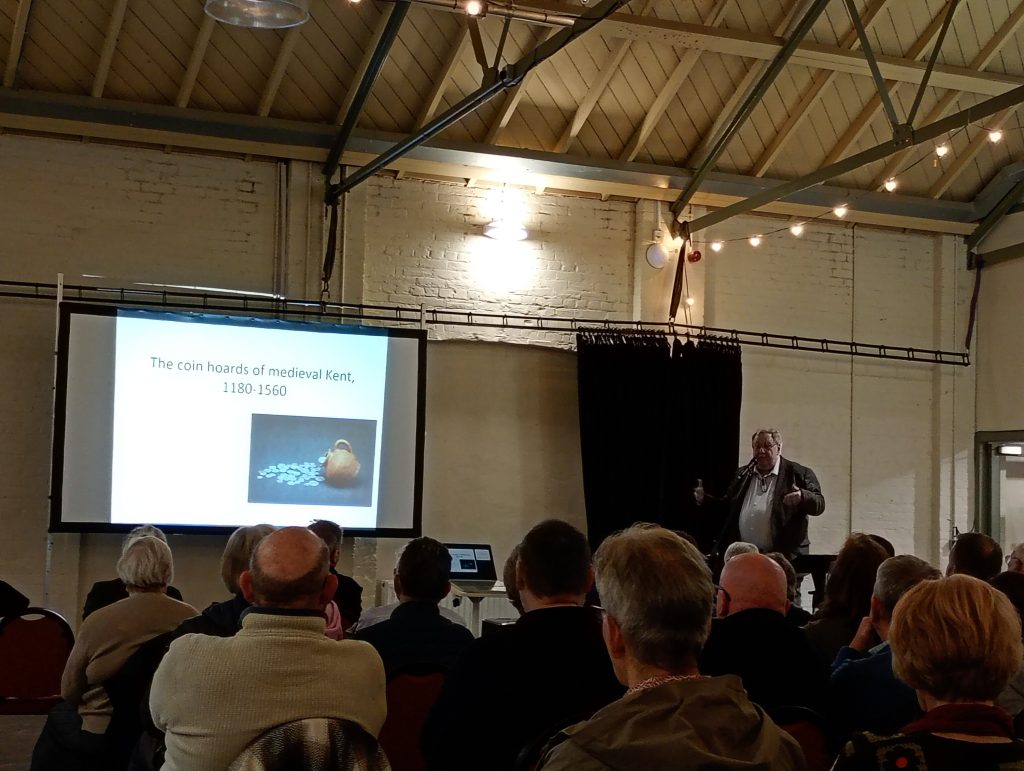
Having introduced his audience to the value of coinage for the historian, Barrie placed Kent in the national context concerning the county’s importance for its number of hoards: 22 for Kent or 26% for the South-East region, stressing that in most cases the total value of the hoards is not massive and seemingly these hoards were due to the rural peasantry, not the hidden treasure of members of the aristocracy. Thereafter, Barrie went through the different chronological phases, starting with the short cross silver coins of the early Angevin kings, and the Kentish hoards link to this phase, such as at Seasalter. The next phase is the long cross coins (1247-79) with the nationally important Kentish hoard from Palmer’s Green, to be followed by Edward 1 to Edward III (1279-1351) and of the 4 Kent hoards the largest is Dover. For each of these, Barrie offered some contextual remarks, although linking these and the hoards is suggestive rather than anything else. Moving on again to 1351-1412, Bredgar is the most important for Kent and a major change is the arrival of gold coins (nobles and half nobles), not just silver. Barrie finished with the Tudor Debasement, albeit Elizabeth was able to restore her coinage to ite ‘just value’, something she was especially proud to have achieved.
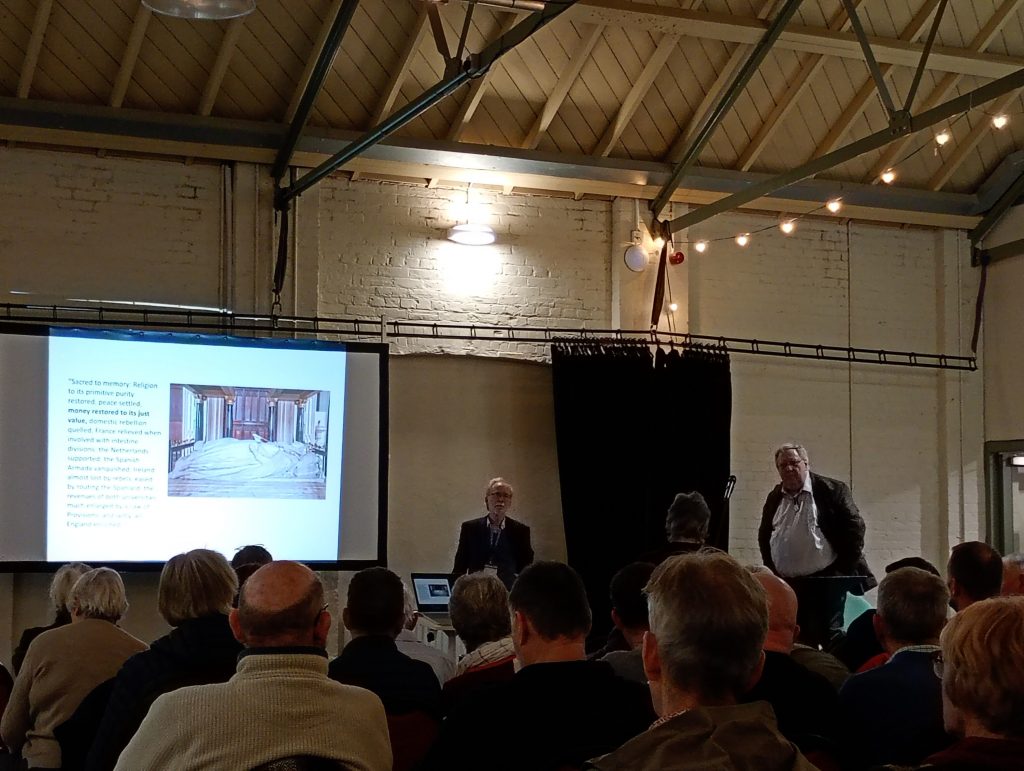
To finish, Barrie answered a considerable number of questions from the engaged audience and the evening was viewed as successful by all concerned. This only leaves me to note that for the next blog I shall be able to report on a meeting of the Maidstone VCH Short project and my talk to the Wye Historical Society.
Categories
academic Blog Posts Canterbury Early Modern Events Heritage Kent Lecture local and regional history Middle Ages NewsBack